











Ikhtisar Tangki Agitasi Pelindian Impeler Ganda GBJ
Apa Itu Tangki Agitasi Pelindian Impeler Ganda GBJ?
Tangki Agitasi Pelindian Impeler Ganda GBJ, juga dikenal sebagai tangki pelindian impeler ganda, tangki agitasi impeler ganda, atau tangki pelindian sianida, adalah bejana pengolahan mineral yang dirancang untuk agitasi dan pelindian bubur secara kontinu. Alat ini terutama digunakan dalam sianidasi emas, Karbon-dalam-Pulp (CIP), dan Karbon-dalam-Leach (CIL) sirkuit, di mana kondisi bubur yang stabil diperlukan untuk pelindian dan adsorpsi yang efektif. Tangki biasanya dipasang di hilir peralatan penggilingan, klasifikasi, dan peralatan pengentalan dan dapat diintegrasikan dengan layar karbon, pompa bubur, dan peralatan lain dalam sirkuit pengolahan.
Untuk Apa Tangki GBJ Digunakan?
Tangki GBJ terutama digunakan untuk pelindian emas dan pengkondisian bubur, khususnya di mana bubur yang digiling halus dan viskositas rendah memerlukan agitasi terkendali selama tahap reaksi. Kondisi referensi tipikal mencakup material -200 mesh yang mencakup lebih dari 90% umpan dan konsentrasi bubur di bawah 45%. Tergantung pada desain proses, tangki juga dapat digunakan untuk pencampuran reagen dan aplikasi hidrometalurgi terkait. Volume tangki, jumlah, dan konfigurasi operasi harus dipilih sesuai dengan kapasitas pabrik, karakteristik bubur, dan waktu tinggal pelindian yang diperlukan.
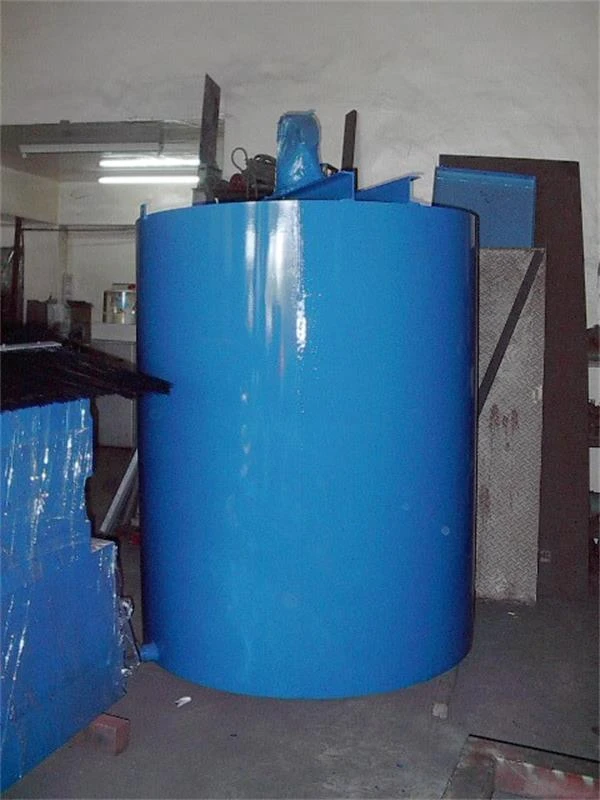
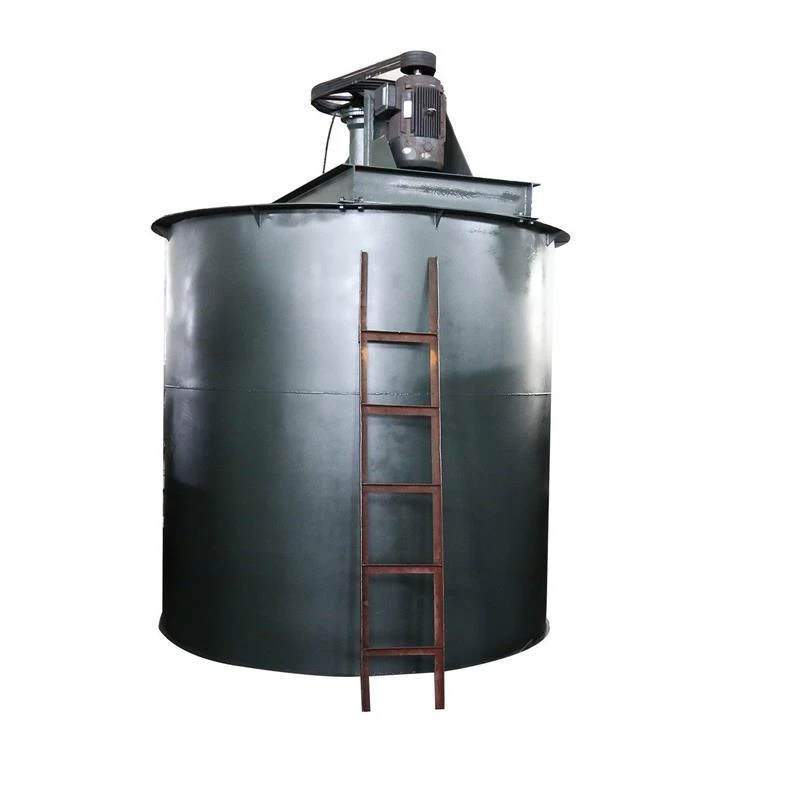
Struktur Tangki Agitasi Pelindian Impeler Ganda GBJ
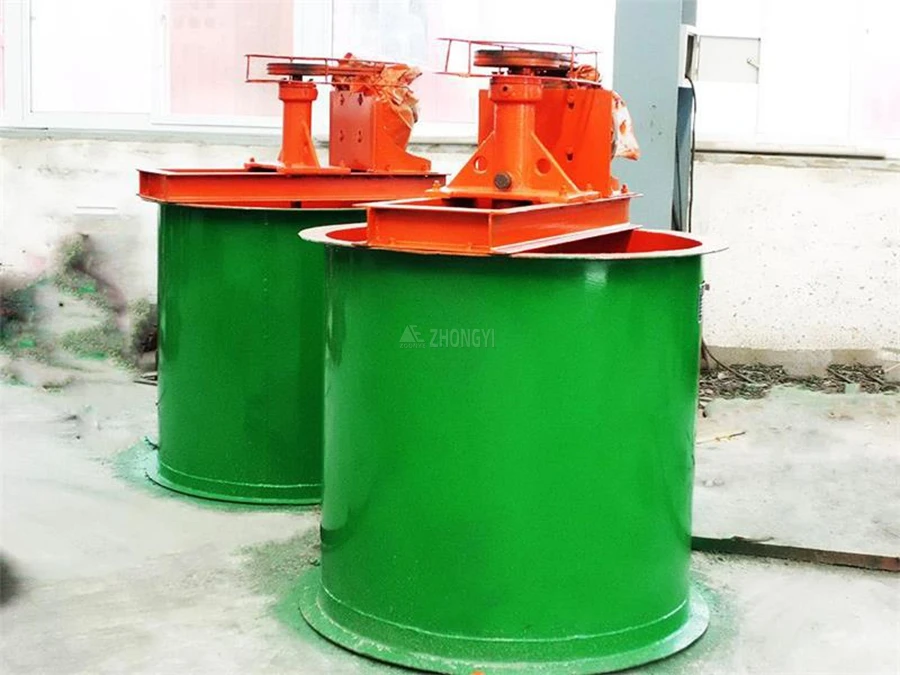
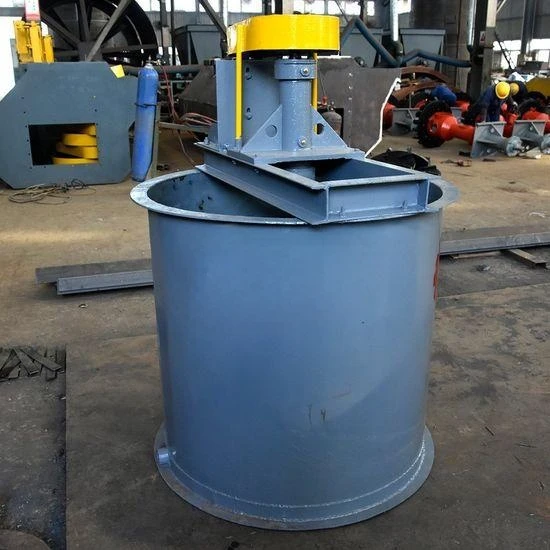
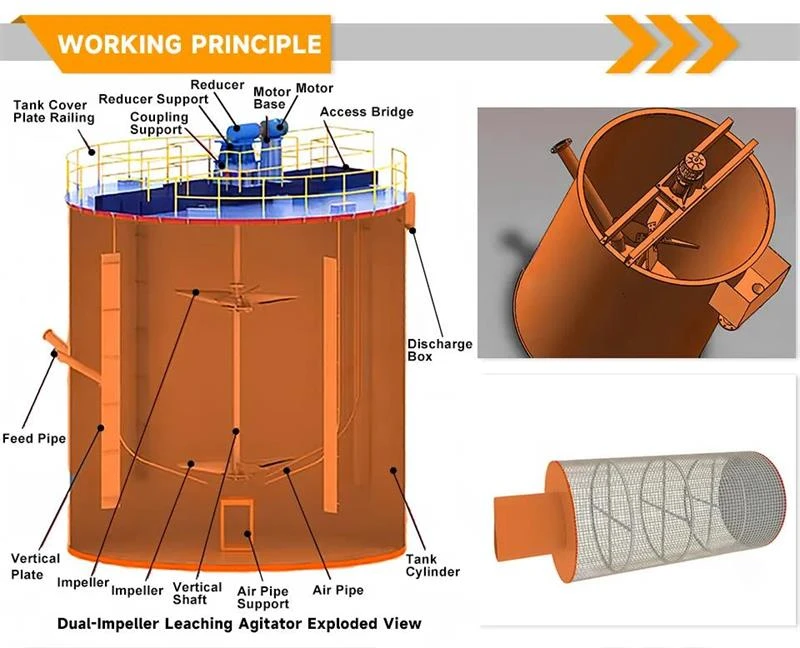
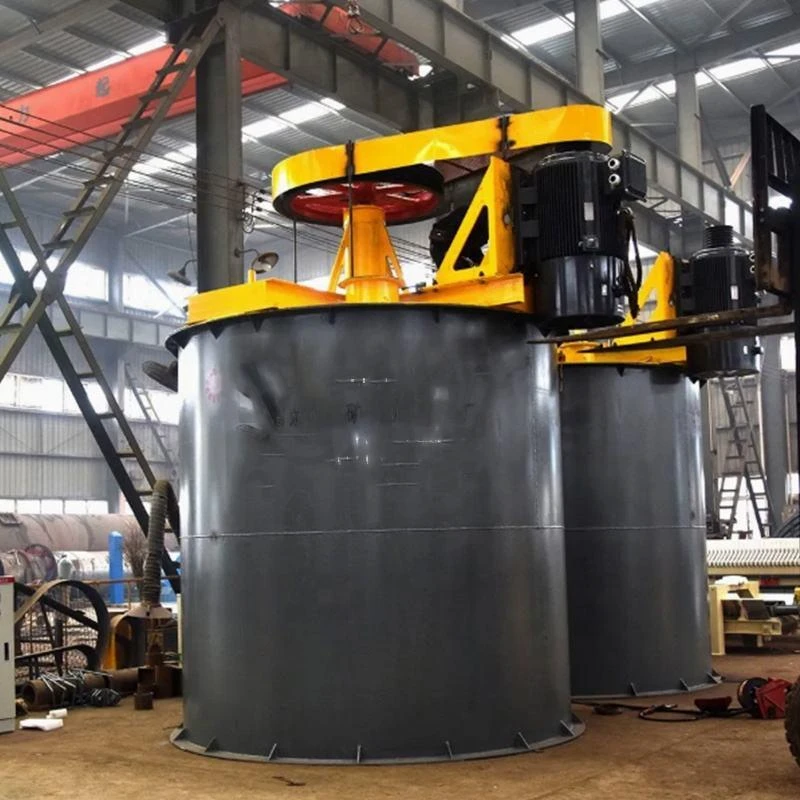
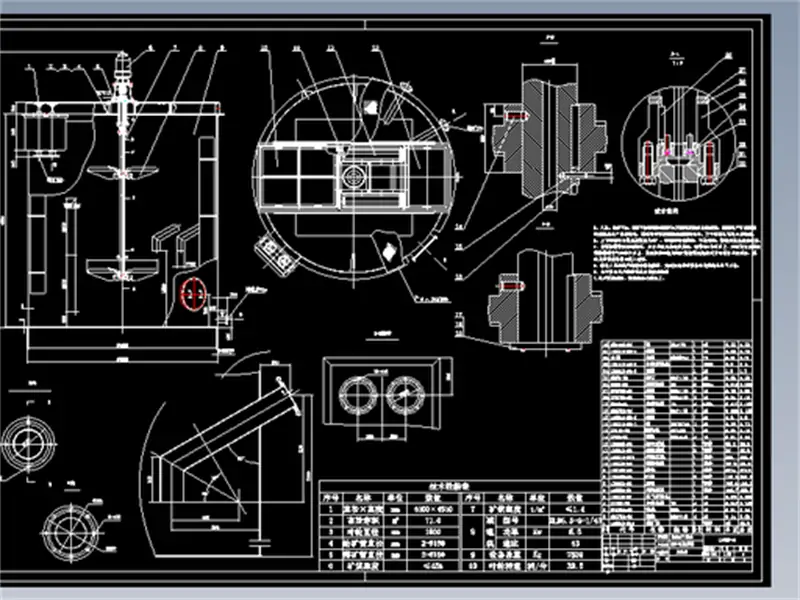
Unit ini terdiri dari badan tangki silindris, rakitan penggerak, poros berongga, impeler atas dan bawah, sistem aerasi, dan sekat internal. Setiap komponen bekerja bersama untuk mempertahankan agitasi dan aerasi bubur yang stabil selama operasi pelindian emas, CIL, dan CIP.
- Badan Tangki: Tangki silindris menyediakan volume kerja untuk pencampuran dan pelindian bubur. Baja karbon umumnya digunakan untuk struktur utama, dengan lapisan karet atau pelapis pelindung lainnya tersedia untuk kondisi bubur yang abrasif atau korosif.
- Rakitan Penggerak: Sistem penggerak terdiri dari motor, reduktor, kopling, rakitan bantalan, dan poros vertikal. Sistem ini menyediakan transmisi daya yang stabil untuk operasi impeler secara kontinu.
- Impeler Ganda: Impeler atas dan bawah dipasang pada posisi berbeda pada poros vertikal. Konfigurasi berdiameter besar dan kecepatan rendah memberikan suspensi bubur yang stabil dan agitasi terkendali.
- Poros Berongga dan Sistem Aerasi: Poros berongga menyediakan saluran internal untuk pengiriman udara ke bagian bawah tangki. Sistem aerasi memasok udara untuk mendukung proses pelindian pada kondisi operasi yang diperlukan.
- Sekat dan Komponen Tambahan: Sekat internal membantu mengendalikan pergerakan bubur dan mengurangi pusaran berlebihan. Komponen tambahan meliputi katup udara, segel poros, bukaan inspeksi, dan sambungan bubur. Sirkuit CIL dan CIP juga dapat mencakup layar karbon dan peralatan transfer karbon.
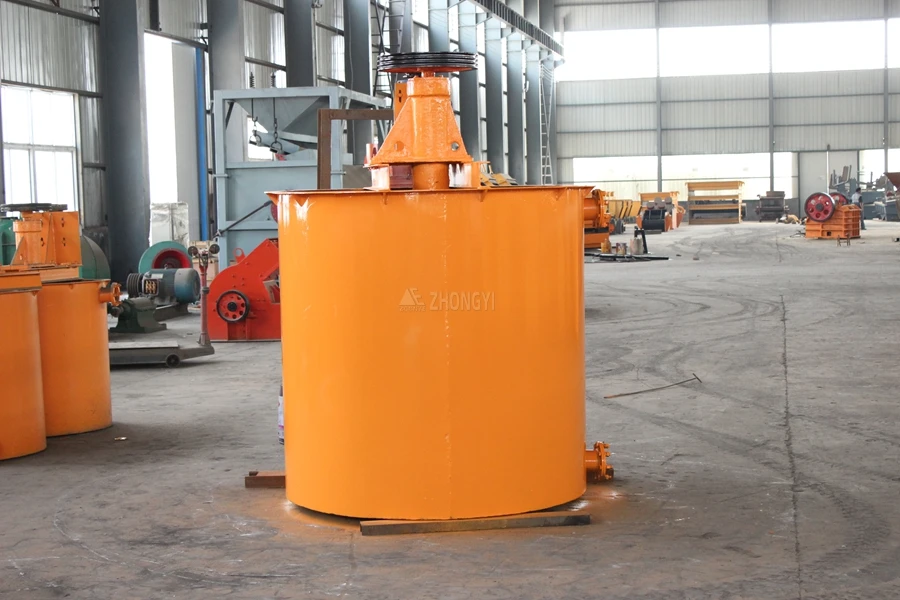
Bagaimana Cara Kerja Tangki Agitasi Pelindian Impeler Ganda GBJ?
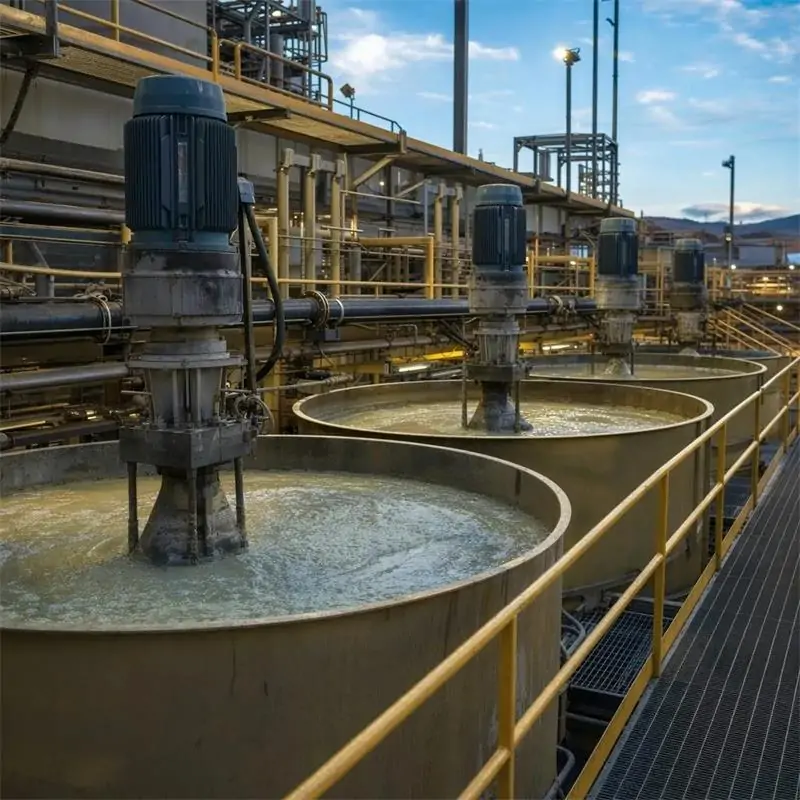
Dalam sirkuit pelindian, sekadar menjaga bubur tetap bergerak tidaklah cukup. Peralatan harus mempertahankan suspensi yang konsisten, menyediakan kontak yang cukup antara bubur bijih, reagen, dan udara, serta menjaga material tetap bergerak melalui tangki tanpa menciptakan zona mati yang signifikan. Hal ini sangat penting dalam sianidasi emas, di mana agitasi dan aerasi yang stabil secara langsung mempengaruhi kondisi yang tersedia untuk reaksi pelindian. Tangki Agitasi Pelindian Impeler Ganda GBJ bekerja dengan menggunakan dua impeler yang tersusun vertikal untuk menggerakkan sirkulasi bubur sementara udara dan reagen pelindian didispersikan melalui bubur.
Selama operasi, bubur yang masuk didorong ke bawah melalui area tengah tangki oleh impeler atas dan bawah dan kemudian menyebar ke luar di dekat bagian bawah. Udara masuk melalui poros berongga dan didispersikan ke dalam bubur yang diagitasi, sementara sekat internal membantu mengarahkan sirkulasi dan membatasi pusaran berlebihan. Aliran yang dihasilkan menjaga partikel mineral halus tetap tersuspensi dan mendorong kontak kontinu antara permukaan mineral, reagen pelindian, dan oksigen terlarut. Setelah waktu tinggal yang diperlukan, bubur yang tercampur merata mengalir ke tahap pelindian atau adsorpsi berikutnya.
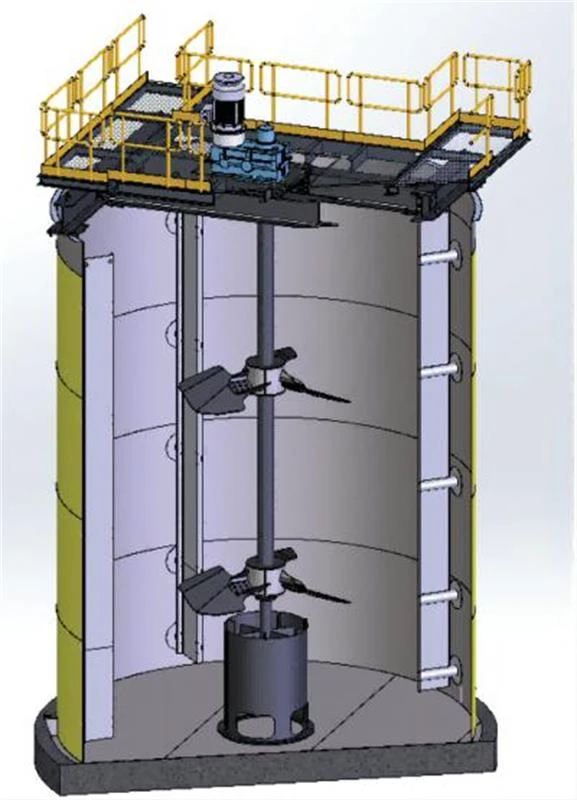
Keunggulan Tangki Agitasi Pelindian Impeler Ganda GBJ
Tangki Agitasi Pelindian Impeler Ganda GBJ menggabungkan susunan impeler dua tingkat, aerasi poros berongga, dan agitasi kecepatan rendah untuk menangani pencampuran bubur kontinu dalam sirkuit pelindian. Fitur desain ini bekerja bersama untuk meningkatkan sirkulasi bubur, dispersi udara, dan stabilitas operasi sambil menjaga keausan dan kebutuhan perawatan tetap terkendali.
Tangki Agitasi Pelindian Impeler Ganda GBJ untuk Ekstraksi Emas
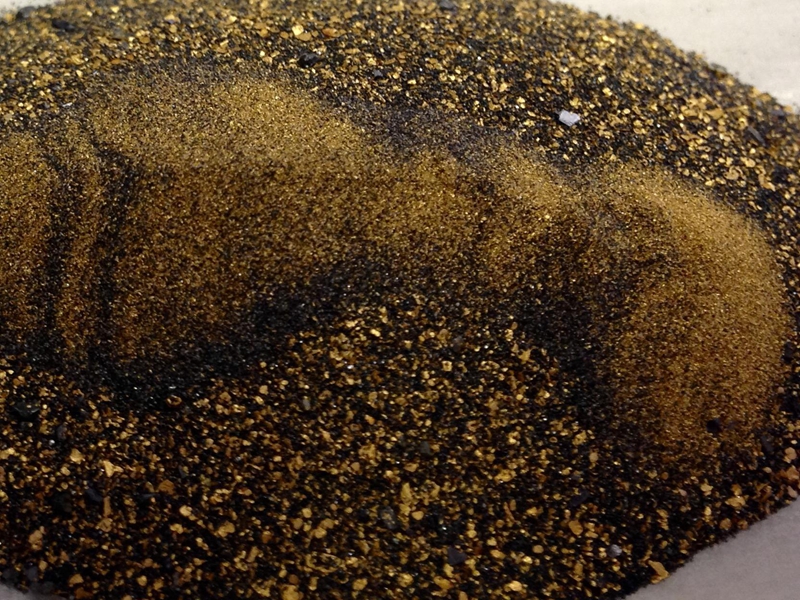
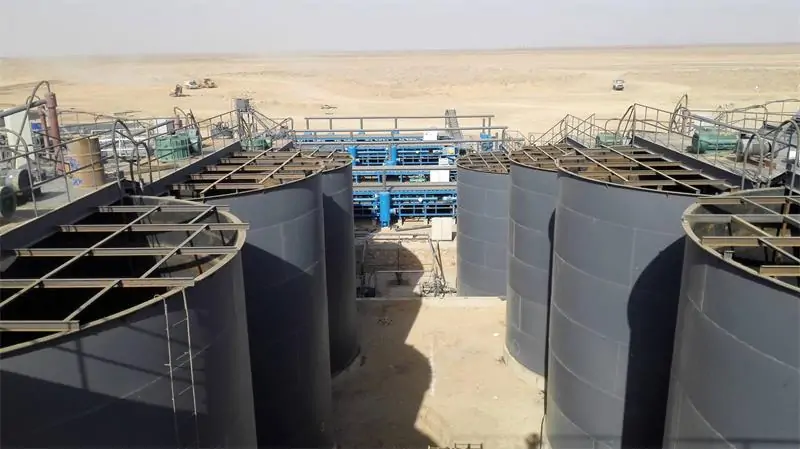
Tangki Agitasi Pelindian Impeler Ganda GBJ digunakan dalam sirkuit sianidasi emas pada tahap pelindian. Tangki ini biasanya dipasang setelah penggilingan dan klasifikasi, di mana bubur bijih yang telah disiapkan dicampur dengan larutan pelindian sebelum menuju ke tahap berikutnya. Tangki ini menciptakan kondisi pencampuran yang diperlukan untuk pelarutan emas, bukan untuk memulihkan emas itu sendiri.
Kondisi Bubur dan Rentang Aplikasi
Memilih tangki agitasi pelindian memerlukan lebih dari sekadar memeriksa kapasitas pengolahan. Ukuran partikel, konsentrasi bubur, viskositas, perilaku pengendapan, dan karakteristik bijih semuanya memengaruhi konfigurasi tangki yang diperlukan. Kondisi berikut adalah nilai referensi tipikal, sedangkan pemilihan akhir harus didasarkan pada bubur aktual dan persyaratan proses.
Ukuran Partikel dan Konsentrasi Bubur
Kondisi referensi tipikal adalah material -200 mesh di atas 90%, dengan konsentrasi bubur pada ≤45%. Nilai-nilai ini bukan batas tetap untuk setiap aplikasi. Ukuran penggilingan dan konsentrasi bubur aktual bergantung pada sifat bijih, persyaratan pelindian, kepadatan bubur, dan waktu tinggal yang diinginkan.
Sifat Bubur dan Karakteristik Bijih
Viskositas bubur, kepadatan padatan, perilaku pengendapan, dan kandungan lempung secara langsung memengaruhi kinerja agitasi dan kebutuhan daya. Oleh karena itu, mineralogi bijih dan kinetika pelindian harus dipertimbangkan bersama dengan ukuran partikel dan konsentrasi saat memilih tangki. Untuk bubur dengan kandungan lempung tinggi atau yang sulit disuspensikan, impeler, motor, volume tangki, dan kondisi operasi mungkin memerlukan evaluasi rekayasa tambahan.
Spesifikasi Teknis Tangki Agitasi Pelindian Impeler Ganda GBJ
Spesifikasi utama seri GBJ tercantum di bawah ini. Model standar mencakup berbagai volume kerja, dengan konfigurasi impeler dan penggerak yang disesuaikan dengan ukuran tangki.
| Model | Volume Efektif (m³) | Kecepatan Impeler (r/menit) | Diameter Impeler (mm) | Model Motor | Daya Motor (kW) | Berat (t) |
| GBJ-1000×1000 | 0.58 | 530 | 350 | Y112M-6 | 2.2 | 0.55 |
| GBJ-1250×1250 | 1.15 | 350 | 240 | Y100L2-4 | 3 | 1.11 |
| GBJ-1500×1500 | 2.2 | 320 | 420 | Y132M2-6 | 5.5 | 2.21 |
| GBJ-2000×2000 | 5.6 | 240 | 560 | Y160M-6 | 7.5 | 3.11 |
| GBJ-2500×2500 | 9.2 | 272 | 560 | Y180L-6 | 15 | 3.95 |
| GBJ-3000×3000 | 19.1 | 211 | 700 | Y225S-8 | 18.5 | 4.61 |
| GBJ-4000×4000 | 45 | 153 | 1000 | Y250M-8 | 37 | 9.56 |
How to Select a GBJ Leaching Agitation Tank?
Selecting a GBJ Double Impeller Leaching Agitation Tank requires matching the tank to the process conditions, not simply choosing a model based on capacity. The main factors include slurry flow rate, residence time, effective volume, impeller configuration, aeration, material selection, and drive system. The following three aspects provide a practical basis for equipment selection.
Determine Tank Volume and Quantity
The required effective volume can be estimated from slurry flow rate and required residence time:
Required Effective Volume = Slurry Flow Rate × Required Residence Time
For continuous leaching, the total volume is normally divided among multiple tanks arranged in series. Tank quantity depends on the required residence time, operating volume, process stages, and whether the circuit uses CIL or CIP. Plant capacity alone is therefore not enough to determine the number or size of tanks. Freeboard, operating level, tank geometry, and process margin should also be considered in the final design.
Match Impeller and Aeration Configuration
Impeller diameter, rotational speed, motor power, and aeration arrangement should be matched to the slurry conditions. Particle size, solids concentration, viscosity, settling behavior, and oxygen requirements all affect the agitation configuration. Typical reference conditions include material finer than 200 mesh accounting for more than 90% of the feed and slurry concentration below 45%. The final impeller and aeration arrangement should be determined from the actual process conditions rather than a fixed standard.
Select Materials and Drive Components
Tank lining, impeller material, shaft, reducer, motor, and sealing components should be selected according to abrasion, corrosion, and operating duty. Rubber-lined components are commonly used where wear protection is required, while drive and aeration configurations can be adjusted for specific process requirements. For CIL and CIP plants, the tank configuration should also be coordinated with carbon screens, carbon transfer equipment, slurry pumps, and the rest of the process flowsheet.
GBJ Double Impeller Leaching Agitation Tank Manufacturing and Quality Control
The manufacturing of a GBJ Double Impeller Leaching Agitation Tank involves several stages, from component fabrication and welding to mechanical assembly and final inspection. Each stage focuses on a different aspect of equipment reliability, with dimensional accuracy, alignment, wear protection, and operating performance checked before the tank is prepared for shipment.
Common Problems in GBJ Leaching Agitation Tank Operation
During continuous leaching operation, most problems are related to slurry suspension, aeration, agitation intensity, and mechanical loading. Identifying the operating cause rather than simply replacing a component helps reduce unplanned downtime and maintain stable leaching conditions.
Why Choose Zhongyi Machinery?
Zhongyi Machinery has more than 16 years of experience in mineral processing equipment manufacturing, with a 40,000+ m² production base and more than 60 sets of processing equipment. We manufacture and supply equipment for mining, metallurgy, chemical processing, and environmental applications, with products exported to Southeast Asia, West Asia, Africa, and Latin America.
Beyond equipment manufacturing, we support customers through ore testing, equipment selection, process design, installation, and commissioning. Our experience serving mining and metallurgical enterprises helps us address practical requirements such as slurry conditions, tank sizing, agitation configuration, and process integration, from equipment selection through site operation.
Minta Solusi yang Disesuaikan
Partner with Zhongyi for a GBJ Double Impeller Leaching Agitation Tank engineered for stable slurry mixing, effective aeration, and reliable operation in gold leaching, CIL, CIP, and hydrometallurgical processing applications.
Custom Solutions
Every leaching circuit has different ore characteristics, slurry conditions, capacity, and residence-time requirements. Tell us your ore type, processing capacity, slurry concentration, particle size, and process requirements, and our engineering team can recommend the appropriate GBJ tank volume, quantity, agitation, aeration, and supporting equipment. Where a complete process is required, we can also integrate the tank into a [Mineral Flotation Plants Solution] and other mineral processing solutions. Contact Zhongyi Machinery for a tailored equipment recommendation and quotation.
Harap Berikan Informasi Berikut:
FAQ
Apa Itu Tangki Agitasi Pelindian Impeler Ganda GBJ?
A GBJ Double Impeller Leaching Agitation Tank is used for continuous slurry agitation and aerated leaching in mineral processing plants. Its two-level impeller arrangement promotes slurry circulation, while the hollow shaft can introduce air into the tank. It is commonly applied in gold cyanidation, CIL, CIP, and other hydrometallurgical processes requiring controlled mixing and aeration.
What Is a GBJ Leaching Agitation Tank Used For?
The tank is mainly used for gold cyanide leaching, CIL and CIP circuits, and other hydrometallurgical slurry processes. It keeps finely ground mineral pulp suspended and promotes contact between the ore, reagents, and air during the required residence time. The final application depends on slurry characteristics, process conditions, and the overall plant flowsheet.
Can GBJ Tanks Be Used for CIL and CIP Gold Processing?
Yes. GBJ tanks can be incorporated into both CIL and CIP gold processing circuits. In CIL plants, leaching and carbon adsorption occur in the same tank series, while CIP circuits normally use separate leaching and adsorption stages. Tank arrangement, volume, aeration, agitation, and carbon-handling equipment should be determined according to the specific process flowsheet.
What Particle Size and Slurry Concentration Are Suitable?
Typical reference conditions include material finer than 200 mesh accounting for more than 90% of the feed and slurry concentration below 45%. These values are not universal operating limits. Final selection should consider particle size distribution, solids density, viscosity, settling behavior, ore characteristics, and the residence time required by the leaching process.
How Do You Select the Required Leaching Tank Volume?
Required tank volume is primarily related to slurry flow rate and residence time. A basic calculation is Effective Volume = Slurry Flow Rate × Residence Time. For continuous leaching, the total volume is normally distributed among several tanks in series. Final sizing also considers operating level, freeboard, process stages, slurry characteristics, and available installation space.
Why Does Slurry Settle at the Bottom of a Leaching Tank?
Bottom settling usually occurs when agitation intensity is insufficient for the slurry’s solids concentration, particle size, or settling characteristics. Impeller diameter, rotational speed, and bottom clearance should be reviewed together. Excessive buildup should also be removed promptly, as accumulated solids can restrict circulation, reduce effective tank volume, and increase the mechanical load on the agitation system.
How Can Activated Carbon Wear Be Reduced in CIL or CIP Tanks?
Activated carbon wear is influenced by impeller speed, agitation intensity, slurry abrasiveness, and carbon movement within the circuit. Operating conditions should be balanced between adequate slurry suspension and excessive mechanical impact. Impeller condition, carbon screen arrangement, and carbon transfer equipment should also be checked when abnormal carbon loss or excessive fines are observed.
Can the GBJ Leaching Agitation Tank Be Customized?
Yes. GBJ tanks can be configured according to processing capacity, slurry characteristics, required residence time, and plant layout. Customization may include tank volume and dimensions, impeller configuration, motor and reducer selection, aeration arrangement, tank material, and protective lining. Customers should provide ore type, capacity, slurry conditions, process type, and site requirements for engineering evaluation.