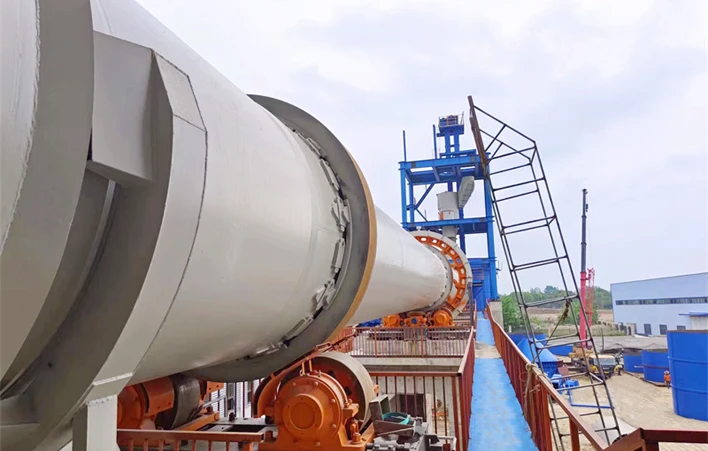
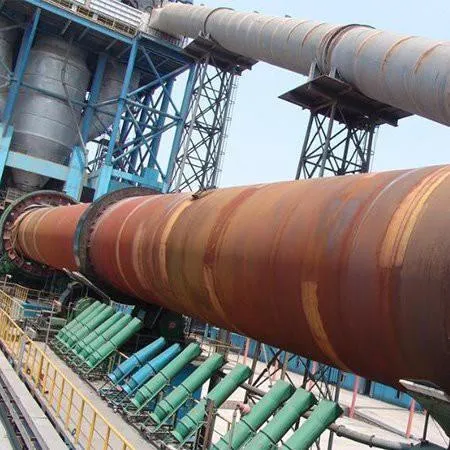
What is an Alumina Rotary Kiln?
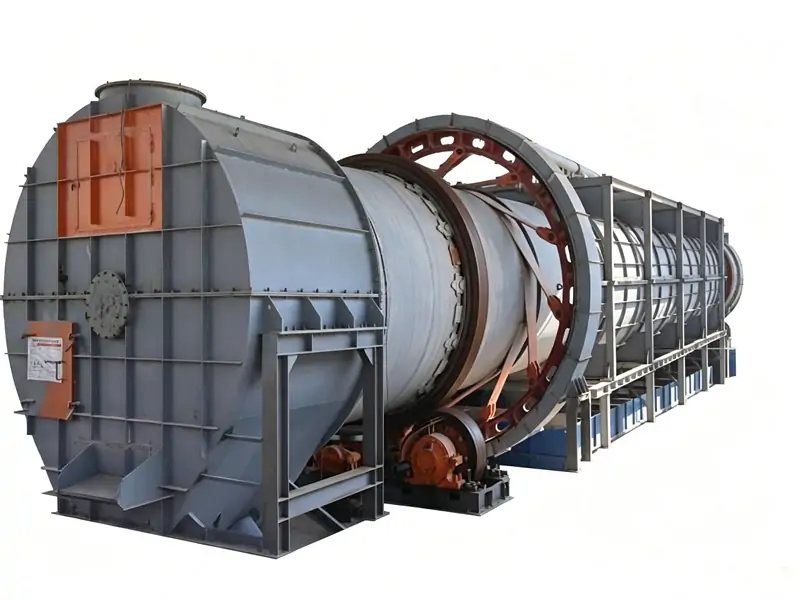
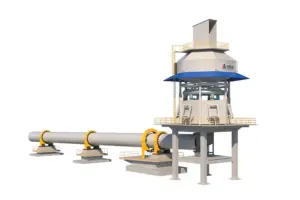
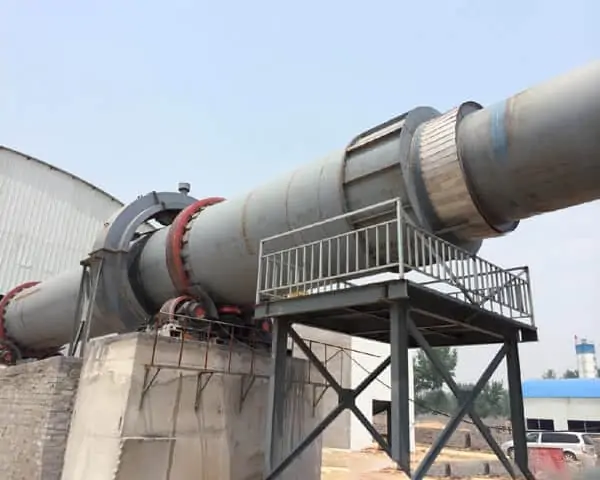
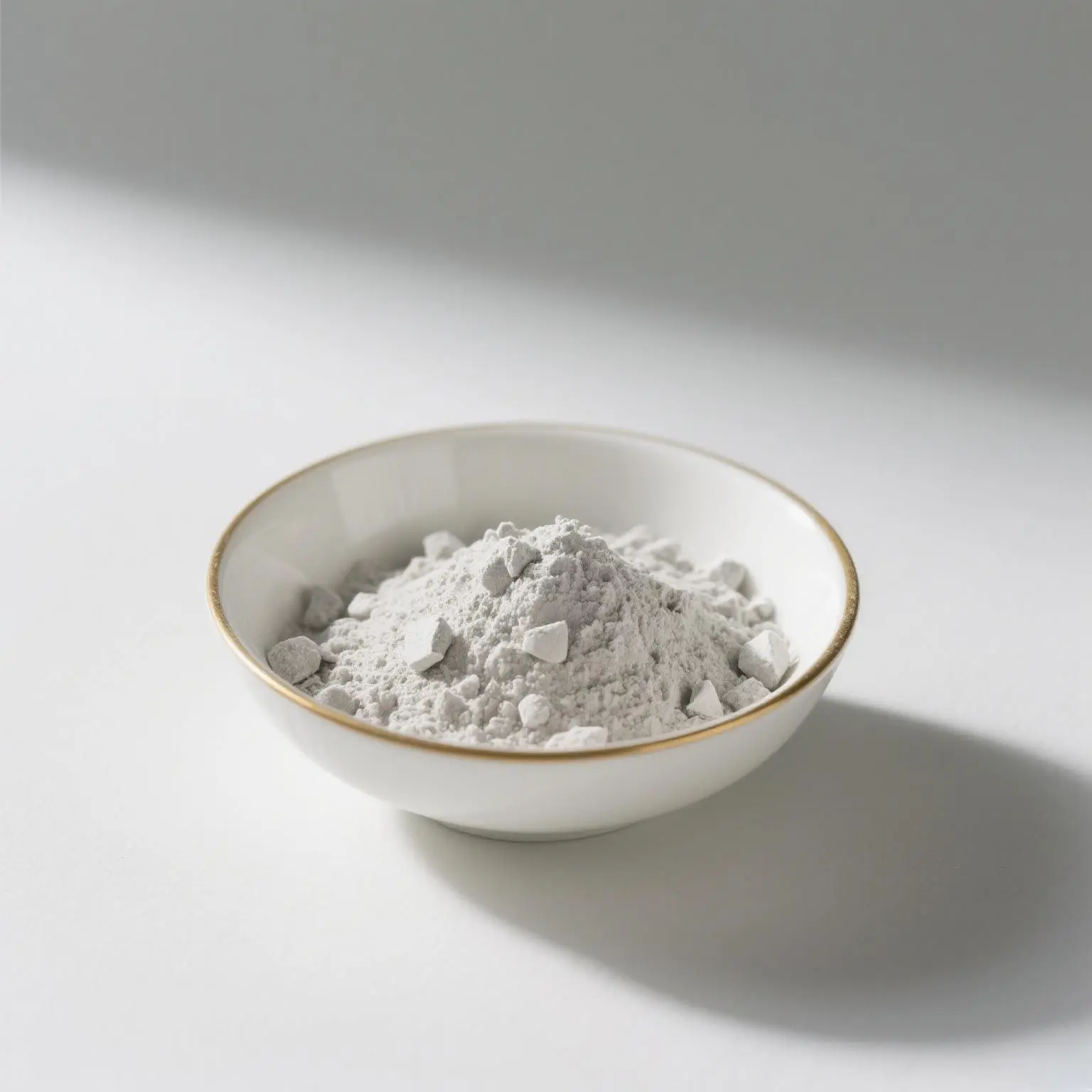
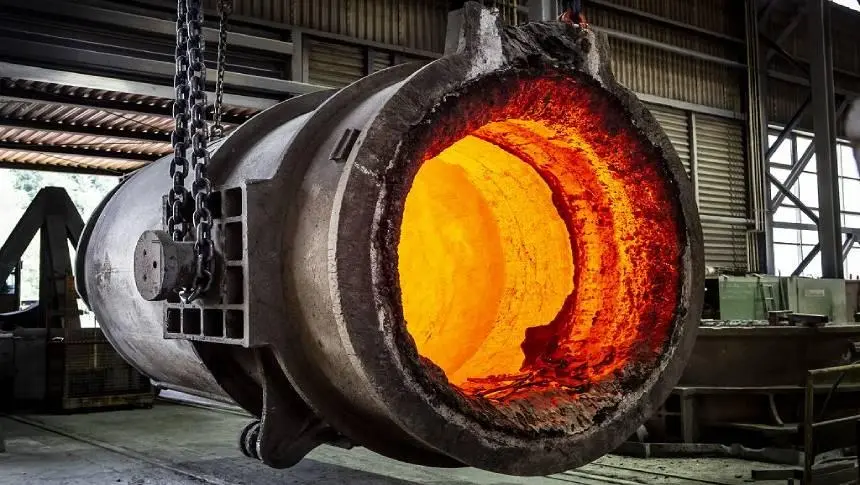
An alumina rotary kiln, also called an alumina calcination rotary kiln or rotary calciner, is a high-temperature rotating furnace used to convert aluminum hydroxide (Al(OH)₃) into calcined alumina (Al₂O₃). It is the final thermal step in the Bayer process before alumina is used for aluminum production. Inside the kiln, the material is heated and dewatered to form a stable alumina product suitable for smelting.
In the production line, the kiln works between the precipitation and filtration section on the upstream side and the cooling, storage, and electrolysis feeding system on the downstream side. Aluminum hydroxide from the wet process enters the kiln, undergoes calcination at around 1200–1,300°C, then exits as hot alumina. It is then cooled, stored in silos, and sent to electrolytic aluminum cells for further processing, mainly used in alumina refineries and primary aluminum production lines.
Components
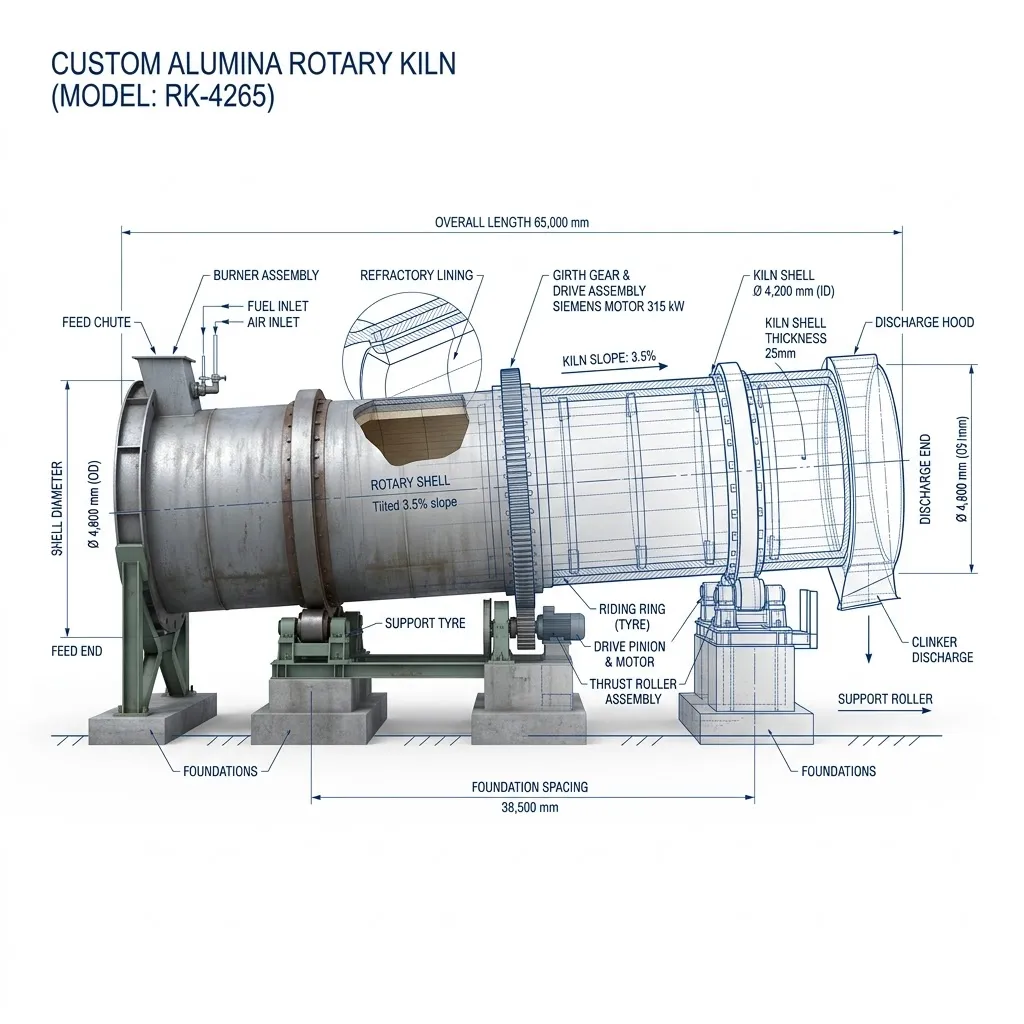
An alumina rotary kiln is composed of several key systems, including the kiln shell, refractory lining, support rollers system, driving system, sealing system, burner system, feeding and discharging system, and control system.
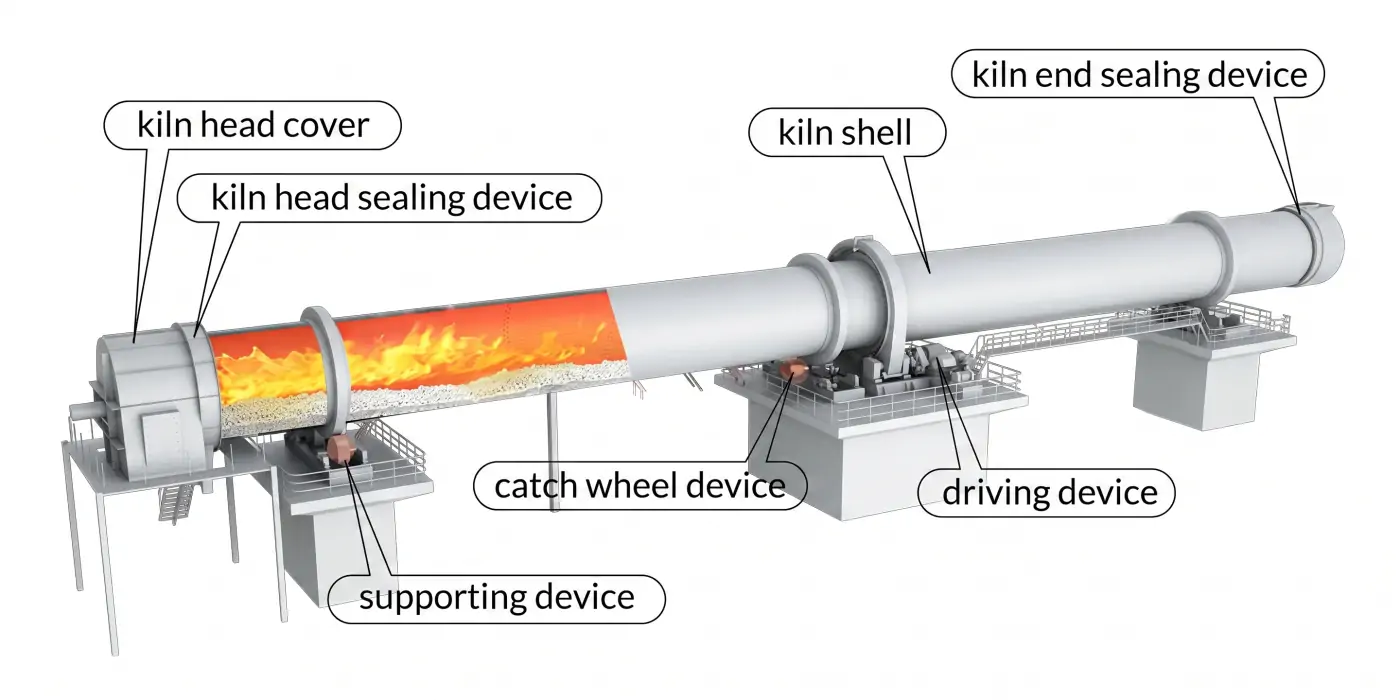
- Kiln Shell: The main rotating structure of the kiln, designed to withstand high mechanical load and thermal stress during continuous operation.
- Refractory Lining: High-temperature resistant lining inside the shell, used to protect the kiln body and maintain stable calcination conditions.
- Riding Ring & Support Roller System: Supports the kiln body and ensures stable rotation under heavy load.
- Driving System: Provides rotational power through motor, reducer, and gear transmission system.
- Sealing System: Prevents heat loss and air leakage at kiln inlet and outlet, improving thermal efficiency.
- Burner System: Provides controlled high-temperature heat source for alumina calcination.
- Feeding System: Controls and delivers raw material into the kiln in a stable and continuous manner.
- Discharging System: Discharges calcined alumina materials smoothly for downstream cooling or processing.
- Control System: PLC-based system for monitoring and controlling temperature, speed, and operating conditions.
How Does an Alumina Rotary Kiln Work?
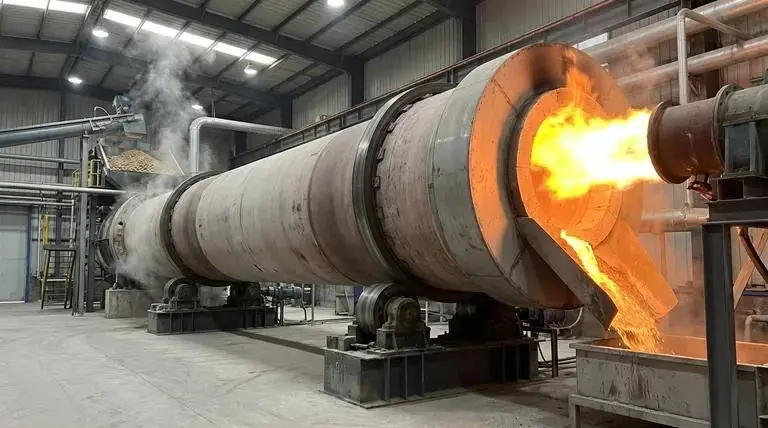
An alumina rotary kiln operates as a counter-current heat exchanger: feed enters the upper (cold) end while hot combustion gases flow from the burner at the lower (hot) end. The 3°–5° inclined shell rotates continuously, conveying material through three thermal zones under controlled atmosphere.
- Damp aluminum hydroxide cake (8–12% moisture) enters the kiln tail through a screw feeder.
- In the drying zone (200–400°C), surface and chemical water evaporates.
- The dehydration zone (450–950°C) transforms Al(OH)₃ into γ-Al₂O₃.
- The calcination zone (1,050–1,200°C) converts γ-Al₂O₃ into stable α-Al₂O₃.
- Calcined product discharges into a satellite or grate cooler, dropping to 80–120°C.
Types of Alumina Rotary Kiln
Alumina rotary kilns are selected according to production capacity, calcination requirements, fuel conditions, and material characteristics. Different kiln structures provide different advantages in heat transfer, energy consumption, and process control. Zhongyi supplies various alumina rotary kiln solutions, including direct-fired rotary kilns, indirect-fired rotary kilns, and customized kiln systems for different alumina calcination projects.
Direct-Fired Alumina Rotary Kiln
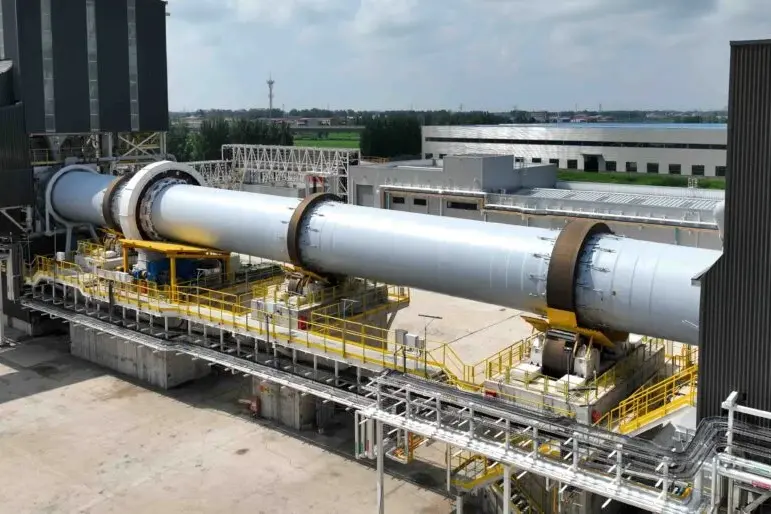
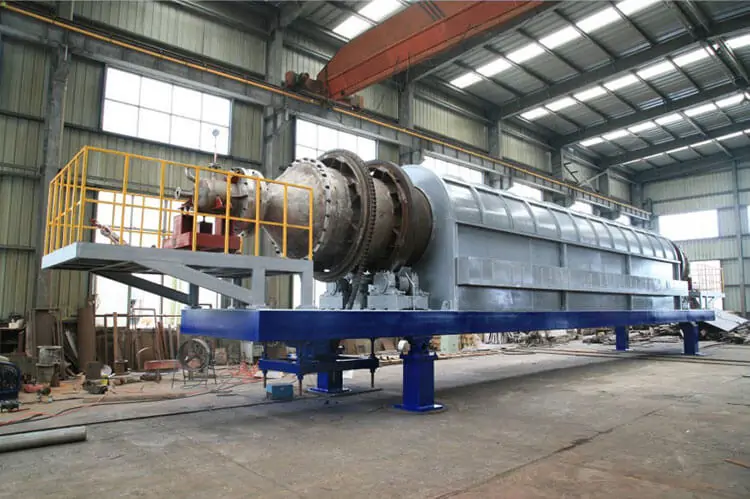
Direct-fired rotary kilns are widely used in industrial alumina production. In this design, the hot combustion gas directly contacts the material inside the rotating kiln, providing efficient heat transfer and stable calcination performance. This type is suitable for large-capacity production lines requiring continuous operation.
- High heat transfer efficiency and large processing capacity
- Suitable for continuous industrial production
- Proven design for large alumina calcination plants
Indirect-Fired Alumina Rotary Kiln
Indirect-fired rotary kilns heat the material through the kiln shell without direct contact between combustion gases and the product. This design is used when material purity and process control are critical, especially for specialty alumina applications.
- Prevents contamination from combustion gases
- Provides better temperature control
- Suitable for high-purity alumina processing
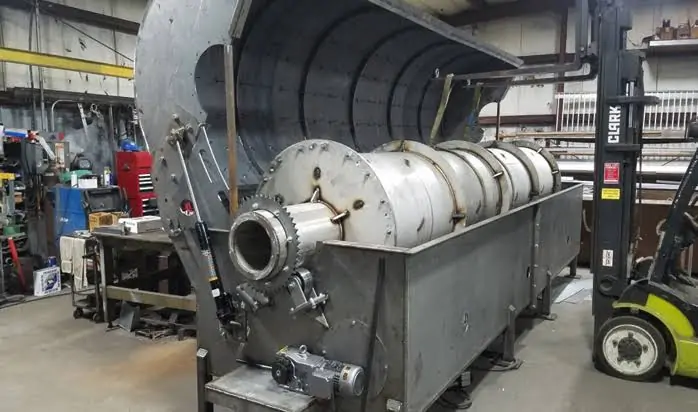
Electric Heating Alumina Rotary Kiln
Electric heating rotary kilns use electrical energy to provide controlled heating during the calcination process. They are mainly used for specialty alumina production, laboratory testing, and applications requiring accurate temperature management.
- Accurate temperature adjustment
- Clean heating process with low emissions
- Suitable for small-scale and special applications
How to Choose the Right Alumina Rotary Kiln?
The right rotary kiln depends on the production scale, raw material characteristics, required product quality, and available energy source. Large alumina plants usually select direct-fired rotary kilns for high efficiency and stable output, while specialty alumina projects may require indirect or electric heating designs.
For complete calcination solutions, Zhongyi provides integrated equipment and engineering services covering rotary kilns, feeding systems, heat recovery, and supporting systems. Learn more about our customized Calcination Plant Solutions for different mineral processing applications.
Specifications
| Model | Kiln Size (m) | Slope | Rotary Speed (rpm) | Capacity (t/d) | Heat Consumption (GJ/t) | Main Motor (kW) |
| ZK-2550 | Φ2.5 × 50 | 3.5% | 0.5–2 | 200–280 | 4.0–4.5 | 75 |
| ZK-3060 | Φ3.0 × 60 | 4% | 0.5–2 | 400–520 | 3.8–4.2 | 115 |
| ZK-3565 | Φ3.5 × 65 | 4% | 0.4–1.8 | 600–780 | 3.6–4.0 | 185 |
| ZK-4070 | Φ4.0 × 70 | 4% | 0.4–1.6 | 850–1,050 | 3.4–3.8 | 280 |
| ZK-4575 | Φ4.5 × 75 | 4% | 0.4–1.4 | 1,150–1,350 | 3.3–3.6 | 450 |
| ZK-4880 | Φ4.8 × 80 | 4% | 0.4–1.4 | 1,400–1,650 | 3.2–3.5 | 630 |
Get a Custom Solution
Zhongyi designs customized rotary kiln systems based on actual production requirements, including kiln structure, heating method, feeding system, and auxiliary equipment.
Applications
Alumina rotary kilns serve any process requiring controlled-temperature dehydration, decarbonation, or phase transformation of mineral powders. Beyond their primary role in Bayer-process alumina refineries, they handle a range of high-purity oxides and refractory raw materials.
Alumina Rotary Kiln vs Stationary Fluid Bed Calciner
Both rotary kilns and stationary fluid bed calciners (FBCs) produce metallurgical-grade alumina, but they differ in heat transfer mechanism, capacity range, and capital intensity. Rotary kilns rely on radiative and conductive heat through a rotating bed; FBCs use suspended-particle convection. The trade-off is operational flexibility against per-ton energy cost.
| Parameter | Alumina Rotary Kiln | Stationary Fluid Bed Calciner |
| Heat Transfer | Conduction + radiation, rotating bed | Convection, fluidized suspension |
| Heat Consumption | 3.2–4.5 GJ/t Al₂O₃ | 2.8–3.2 GJ/t Al₂O₃ |
| Capacity Range | 200–1,500 t/d | 800–4,500 t/d |
| Capital Cost (Relative) | Lower | 2.0–2.5× higher |
| Footprint | Long horizontal layout | Tall vertical column |
| Fuel Flexibility | Gas / oil / pulverized coal | Mostly gas; limited oil |
| α-Al₂O₃ Stability | 92–95% | 95–98% |
| Best For | Capacities ≤1,500 t/d, coal/oil regions | Mega-refineries, gas-supplied sites |
Projects Show
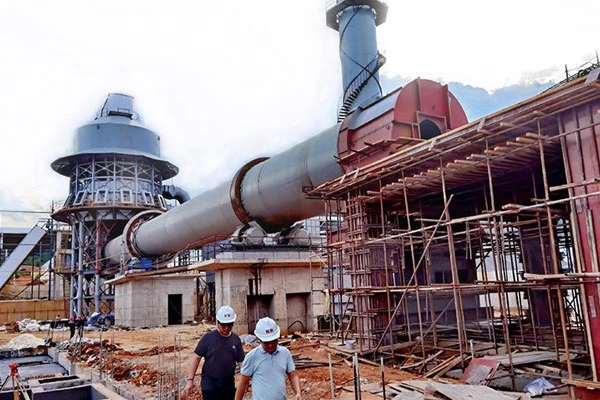
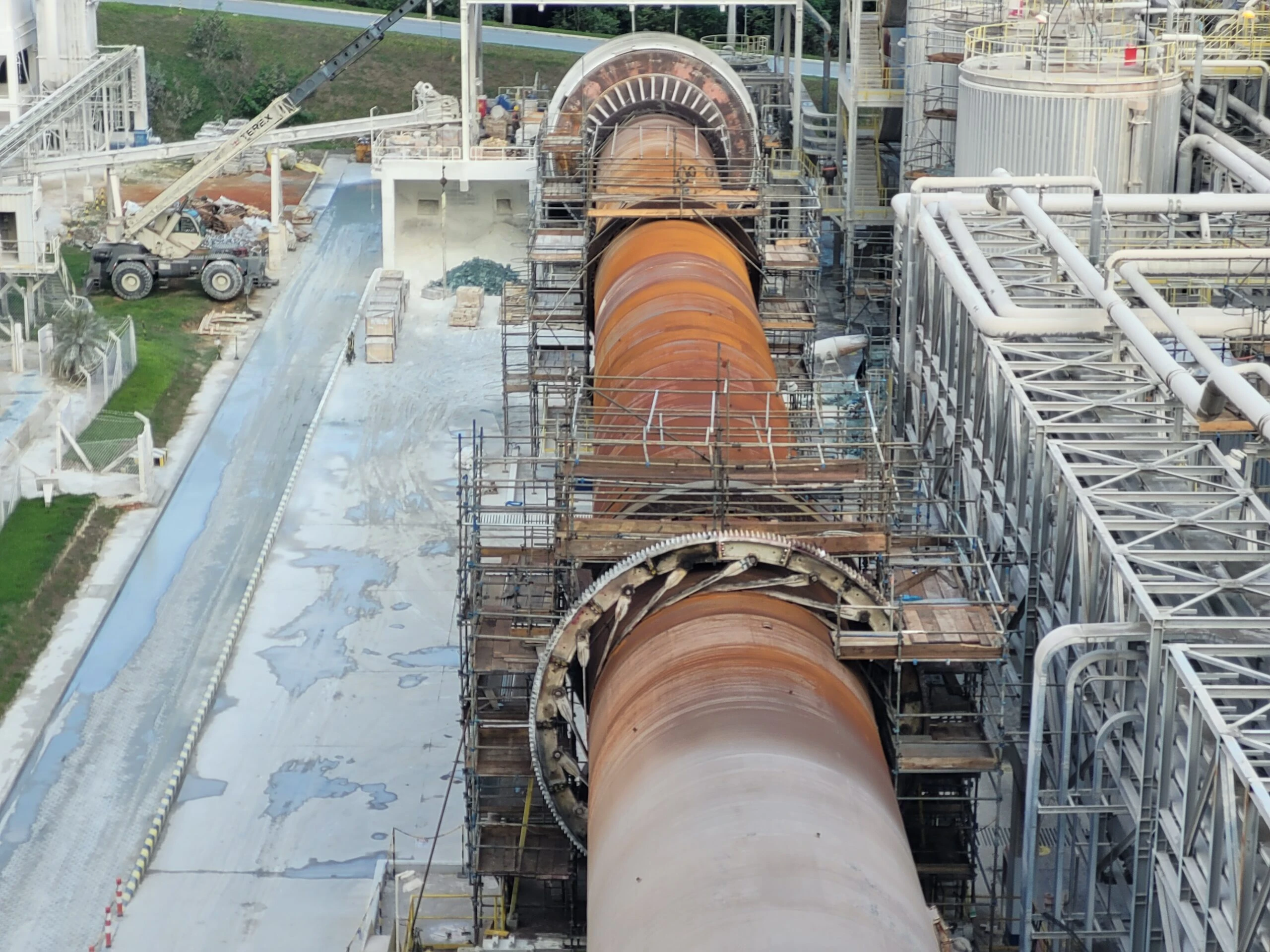
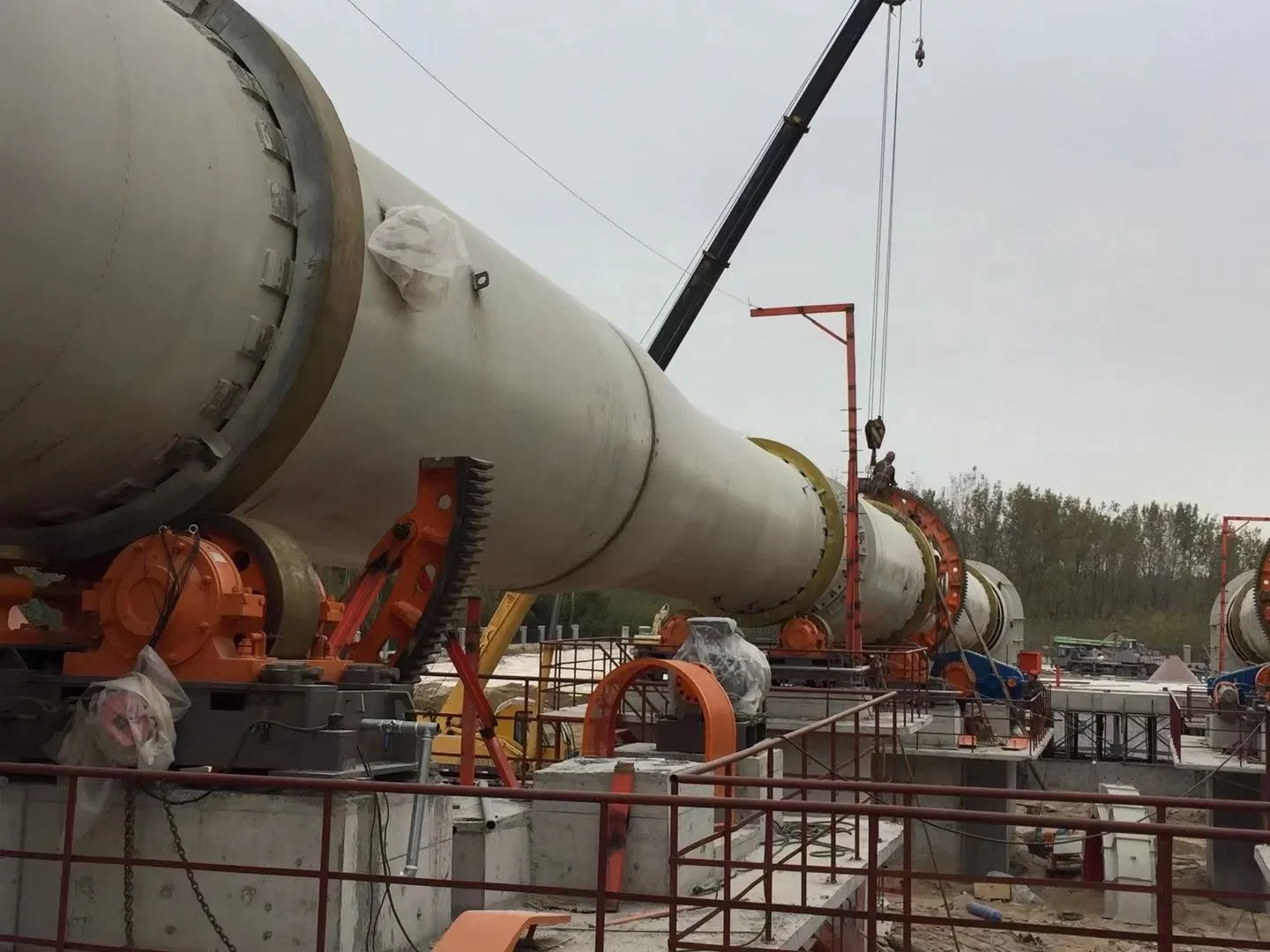
For expert guidance and customized solutions — including free material analysis and process simulation — contact Zhongyi.
Request a Customized Solution
Partner with Zhongyi for expert technical support, customized solutions, and reliable equipment tailored to your ore characteristics and production requirements.
Custom Alumina Rotary Kiln
To get an accurate quotation and a rotary kiln configuration tailored to your alumina production requirements, contact Zhongyi’s engineering team for professional selection support and customized solutions.
Provide the Following Information:
Why Choose Zhongyi?
Zhongyi is a professional manufacturer of alumina rotary kilns and bauxite calcination equipment for the non-ferrous metallurgy industry, delivering process-guaranteed kiln lines with specific heat consumption as low as 3.2 GJ/t Al₂O₃. By evaluating feed moisture, target α-phase, and local fuel supply, Zhongyi configures the right burner system, preheater stages, and refractory profile for each project.
FAQs
What does an alumina rotary kiln do?
It converts aluminum hydroxide [Al(OH)₃] into calcined α-Al₂O₃ at 1200–1,300°C, producing the feedstock for primary aluminum smelting via the Hall-Héroult process.
What capacity range do alumina rotary kilns cover?
Standard Zhongyi models cover 200–1,500 t/d, with kiln dimensions from Φ2.5 × 50 m to Φ4.8 × 80 m matching typical refinery capacities.
Can an alumina rotary kiln calcine materials other than aluminum hydroxide?
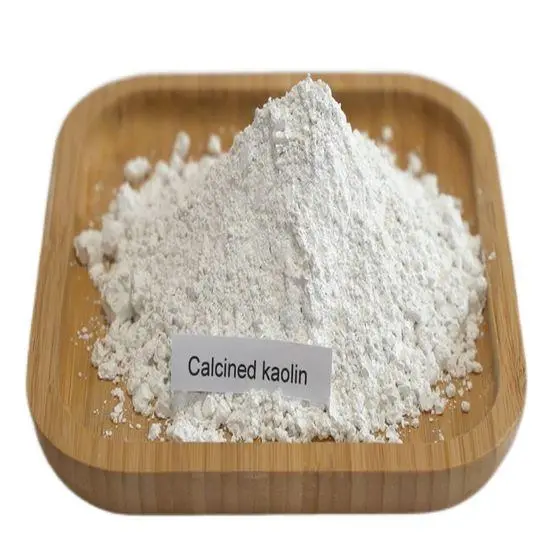
Yes. Adapted designs calcine kaolin, magnesite, lithium carbonate, refractory-grade alumina, and other non-ferrous mineral powders requiring 800–1,300°C heat treatment.
Should I choose a rotary kiln or a stationary fluid bed calciner?
For capacities below 1,500 t/d or where pipeline gas is unavailable, choose a rotary kiln. Mega-refineries above 1,500 t/d with reliable gas favor fluid bed calciners.
What drives the price of an alumina rotary kiln?
Kiln size, fuel system (coal adds 15–25% capex), refractory grade, preheater and cooler type, automation level, and shipping scope are the main drivers.
How do I evaluate an alumina rotary kiln manufacturer?
Check refractory campaign life, ISO9001 and CE certifications, regional service capability, fuel system experience, and process guarantees on heat consumption and α-Al₂O₃ conversion.
What is the typical delivery and commissioning timeline
Equipment fabrication takes 6–10 months depending on size; on-site erection and commissioning add 3–5 months. Zhongyi provides supervisory engineers throughout.
How often does the refractory lining need replacing?
High-alumina bricks in the calcination zone last 18–24 months; magnesia-spinel in the transition zone reaches 24–30 months under continuous operation.