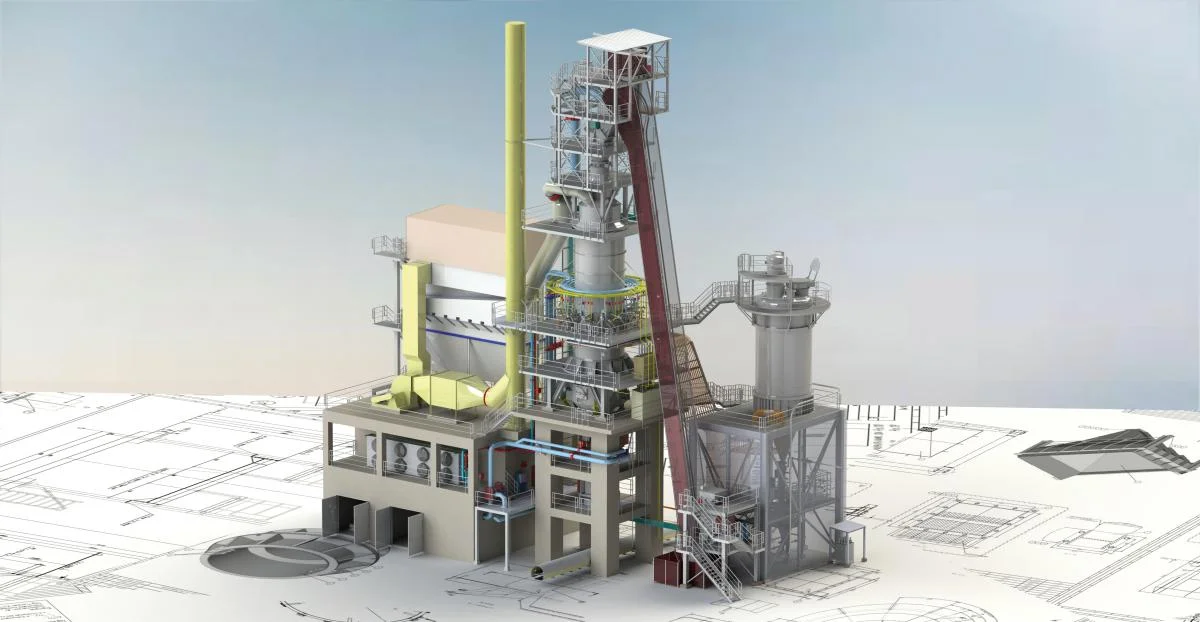
What Is a Vertical Lime Kiln
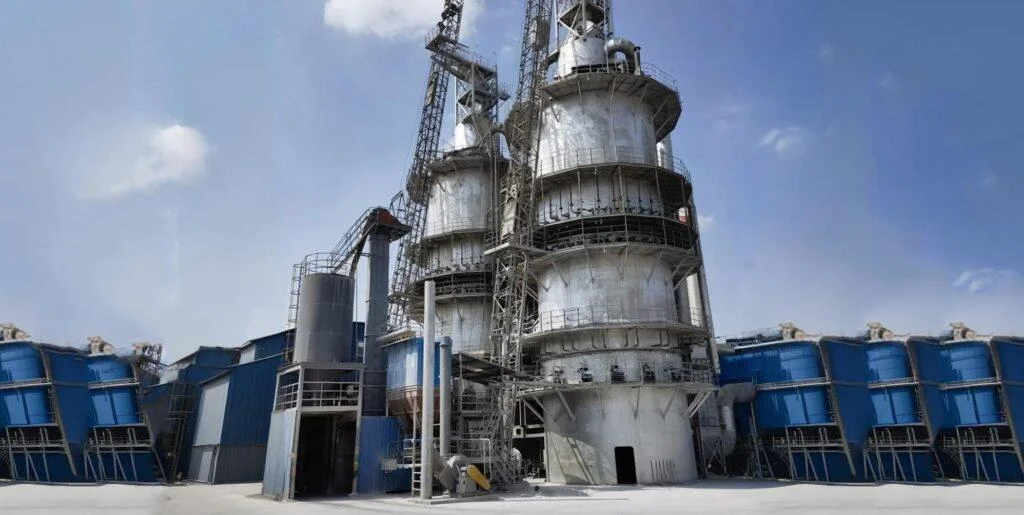
A vertical lime kiln — also called a shaft lime kiln — is a stationary calcination unit that converts limestone (CaCO₃) into quicklime (CaO) through high-temperature decomposition. Installed as the core of a lime production line, it sits between raw stone preparation (crushing and screening to ≤ 80 mm) and downstream product handling (cooling, conveying, storage). Production capacities range from 100 t/d to 600 t/d depending on kiln diameter and height.
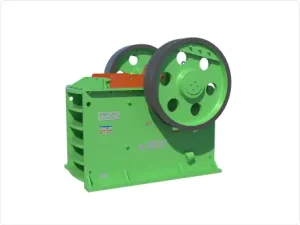
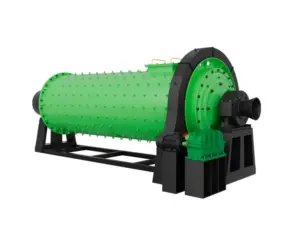
The kiln uses a counter-flow principle: raw stone descends by gravity while hot combustion gases rise from the base. Calcination temperature runs 1,050–1,200 °C with residence times of 20–40 hours depending on stone size. Fuel sources include anthracite coal, coke, natural gas, and blast furnace gas. Finished quicklime reaches CaO content of 85–92% and activity above 300 mL (4N HCl), meeting the requirements of steelmaking and chemical-grade applications. To consistently maintain this critical throat specification, run-of-mine limestone blocks are standardly reduced ahead of the storage silos by an upstream mining jaw crusher circuit.
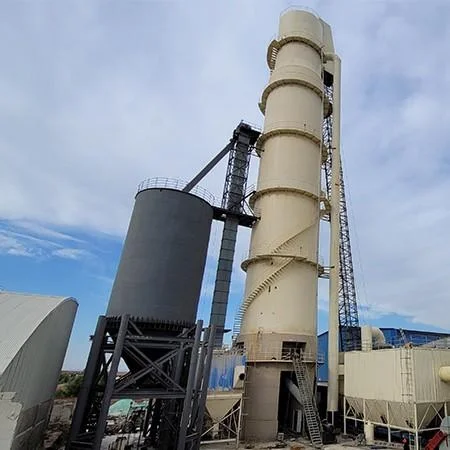
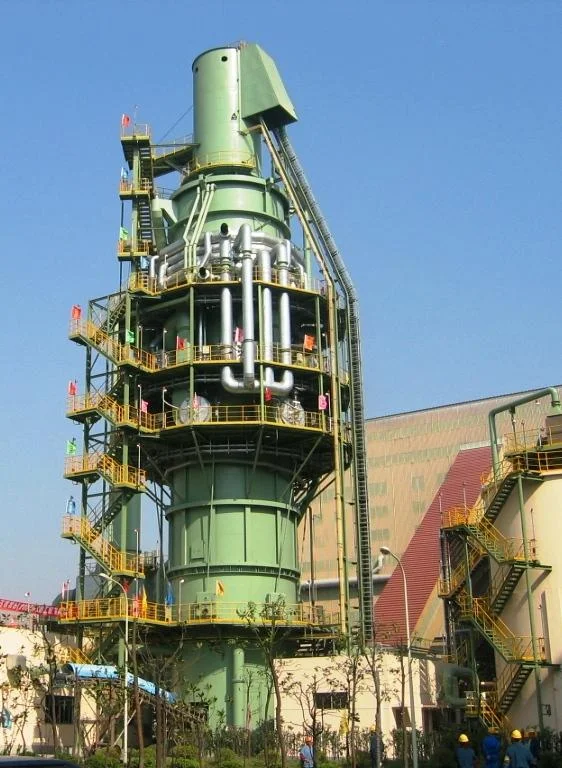
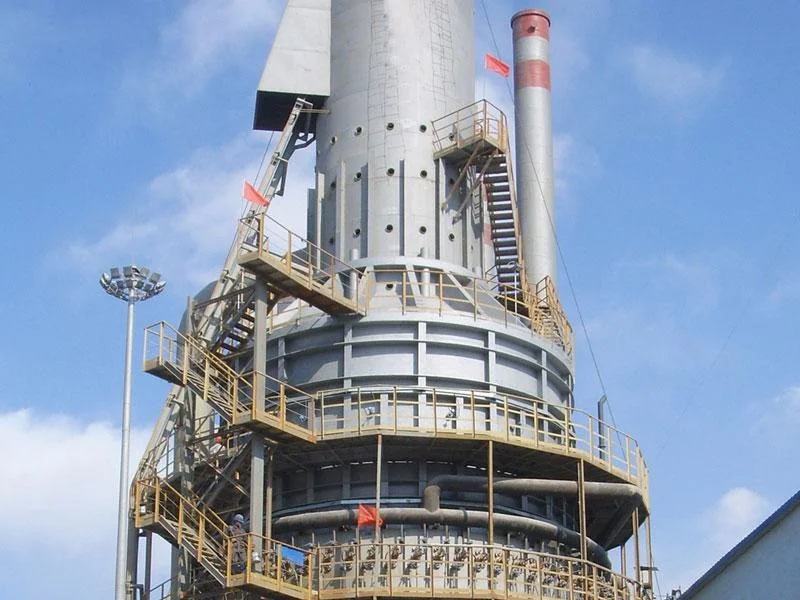
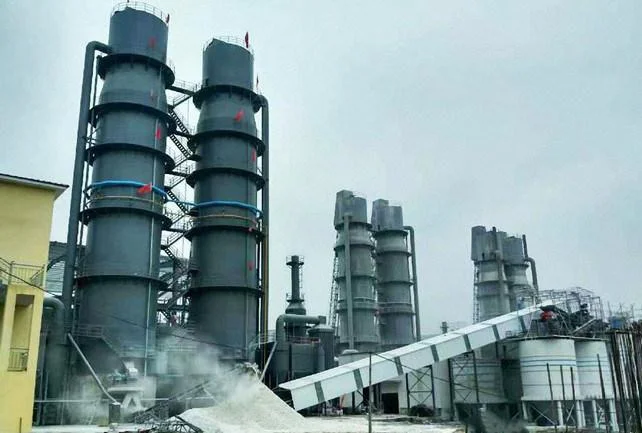
Vertical Lime Kiln Components
A vertical lime kiln consists of several core parts including the kiln shell, refractory lining, feeding system, air distribution system, burner system, discharge system, cooling system, supporting structure, and control system. These components work together to ensure stable limestone calcination and continuous lime production.
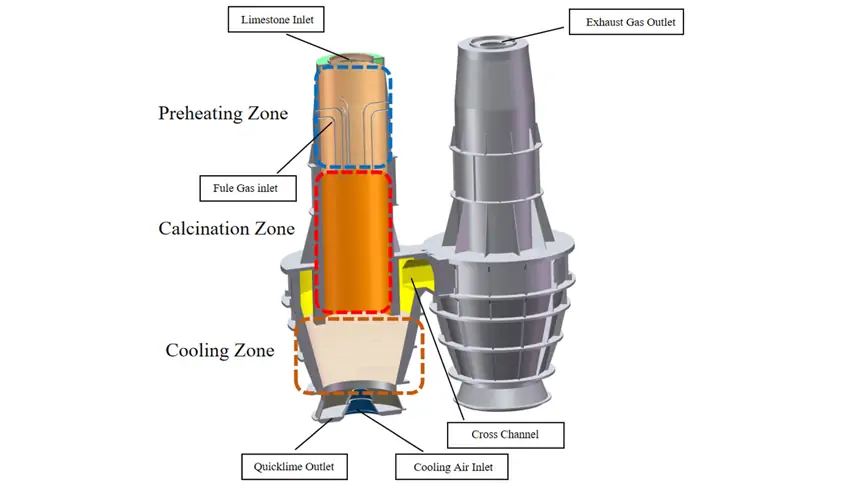
Kiln Shell
Main structural body of the kiln, providing overall support and operating stability under high temperature.
Refractory Lining
Heat-resistant layer inside the kiln that protects the steel shell and maintains calcination temperature.
Feeding System
Feeds limestone into the kiln at a controlled and uniform rate.
Air Distribution System
Controls and distributes airflow inside the kiln to support efficient combustion.
Burner System
Provides the heat required for limestone calcination into quicklime.
Discharge System
Ensures continuous discharge of finished lime from the kiln bottom.
Cooling System
Cools the discharged lime to improve handling and product stability.
Supporting Structure
Provides structural support and keeps the kiln body stable during operation.
Control System
Monitors and controls temperature, airflow, and operating parameters for stable production.
How Does a Vertical Lime Kiln Work?
A vertical lime kiln uses counter-flow calcination: raw limestone descends through the shaft while hot gas rises from the base. Contact between gas and stone enables efficient heat transfer across three zones — preheating in the upper section, calcination in the middle, and cooling at the bottom. Unlike rotary kilns, shaft kilns have no rotating parts, so maintenance focuses on refractory lining rather than mechanical drive systems.
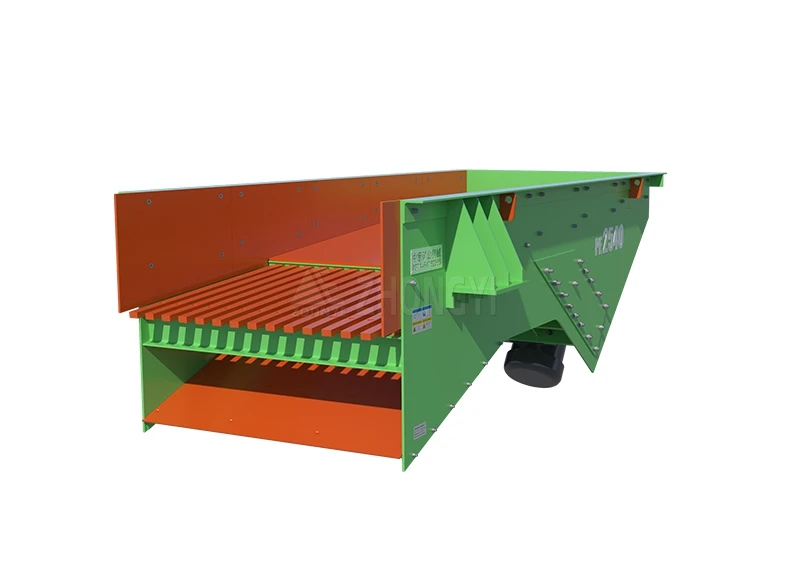
To protect the internal vertical shaft from unpredictable peak-load impacts and maintain a steady material descent, raw stones are precisely regulated prior to the preheating stage. Integrating a heavy-duty zsw series mining vibrating feeder directly before the kiln intake allows operators to scalp out fine soils while continuously regulating controlled limestone fractions into the system.
- Raw stone entry: Raw stone enters from the top hopper after crushing and screening to 40–80 mm; the distributing device spreads it evenly across the shaft.
- Preheating zone: (upper 20–30% of shaft) raises stone temperature from ambient to ~800 °C using waste heat from exhaust gases.
- Calcination zone: (middle 40–50%) reaches 1,050–1,200 °C; CaCO₃ decomposes into CaO + CO₂, completing in 20–40 hours depending on stone diameter.
- Cooling zone: (lower 15–25%) cools quicklime to 60–80 °C using forced air, which also preheats combustion air, improving overall fuel efficiency.
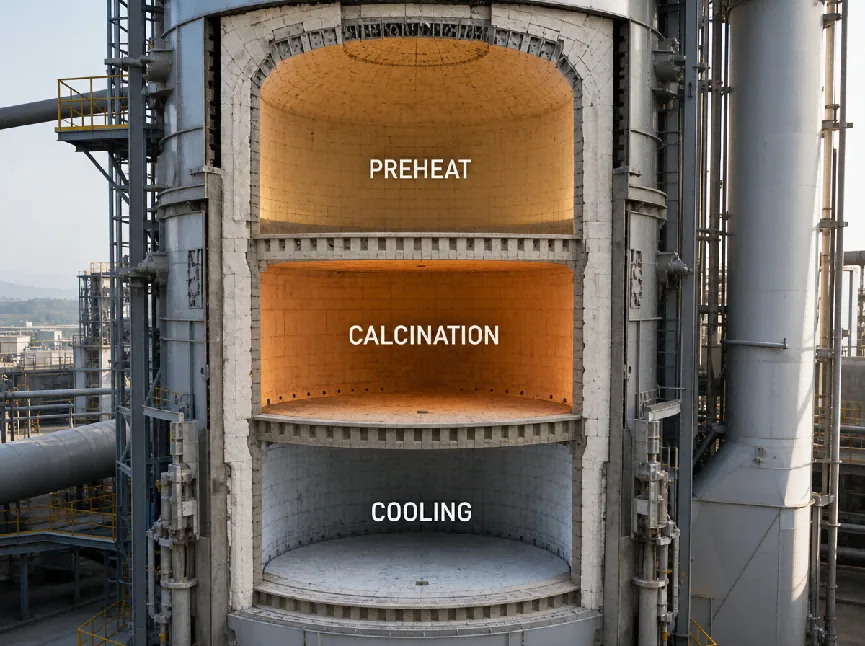
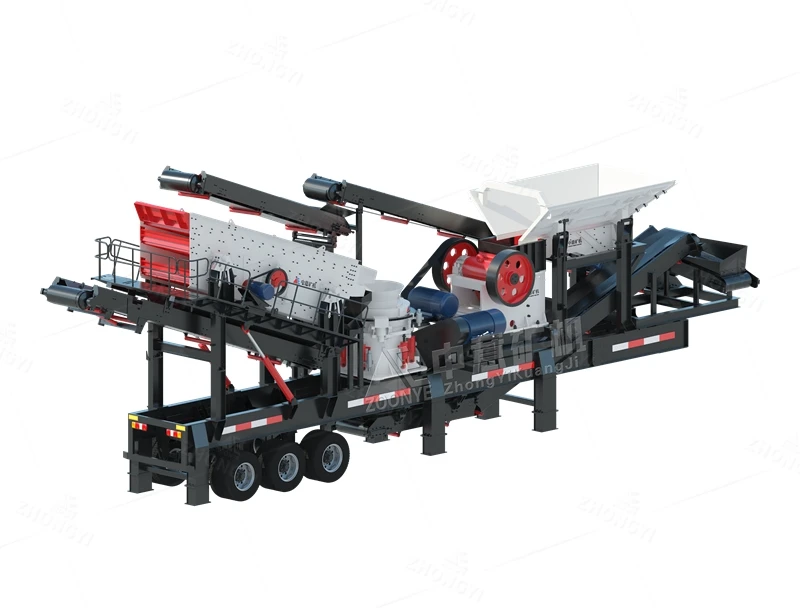
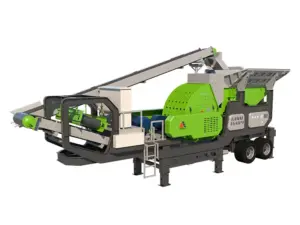
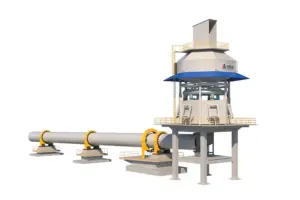
Key performance factors include limestone purity, particle size uniformity, and controlled airflow rates regulated by induced draft fans. To achieve high thermal utilization and seamless material flow across modern continuous infrastructures, these stationary vertical calcination structures are frequently synchronized with high‑capacity mobile crusher plant configurations handling the raw quarry deposits.
Types of Vertical Lime Kiln
Vertical lime kilns are classified by shaft structure and airflow method. Zhongyi manufactures and customizes all types listed below.
| Type | Fuel | Capacity (t/d) | Fuel Consumption | Best For |
| Single-Shell | Anthracite / coke | 50–200 | 135–150 kg coal/t | Small lime plants |
| Double-Shell (Annular) | Anthracite / coke | 200–500 | 110–125 kg coal/t | Steel mills, chemical lime |
| Mixed-Gas / BF-Gas | BF gas / natural gas | 200–600 | 80–100 Nm³ gas/t | Integrated steel plants |
Specifications
| Model | Kiln Diameter | Kiln Height | Capacity (t/d) | Fuel Consumption (kg coal/t) | Motor Power (kW) |
| ZY-VK-20 | 2.0 m | 8 m | 80–120 | 135–145 | 22–30 |
| ZY-VK-25 | 2.5 m | 10 m | 130–180 | 130–140 | 30–45 |
| ZY-VK-30 | 3.0 m | 12 m | 200–280 | 125–138 | 45–75 |
| ZY-VK-35 | 3.5 m | 14 m | 300–400 | 120–135 | 55–90 |
| ZY-VK-40 | 4.0 m | 16 m | 450–600 | 118–130 | 75–120 |
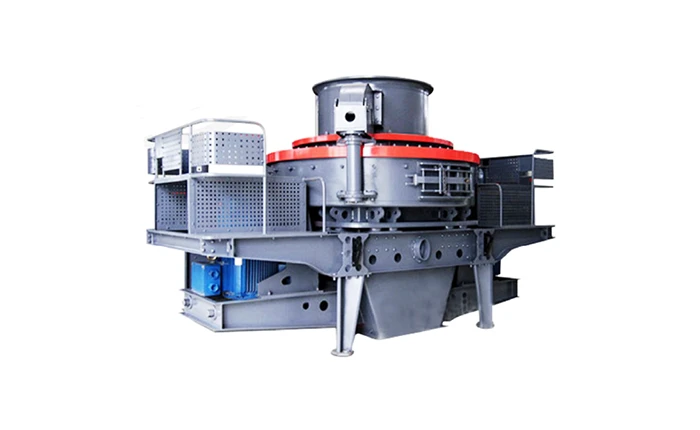
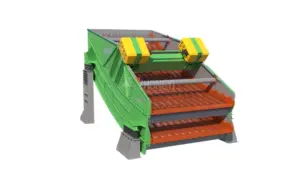
Note: To ensure the final quicklime products meet strict industrial size uniformity, the discharged active lime blocks undergo secondary reduction. The crushed output is standardly routed into an adjacent linear motion vibrating screen to isolate specific fine fractions for storage or hydrated lime processing.
Fuel consumption parameters are calculated based on anthracite coal (calorific value ≥ 6,500 kcal/kg) utilizing limestone with CaCO₃ ≥ 92%. Actual operating values will vary depending on your specific stone purity, material moisture, and custom kiln configuration. Please contact the Zhongyi engineering team for a project-specific thermal calculation.
Applications
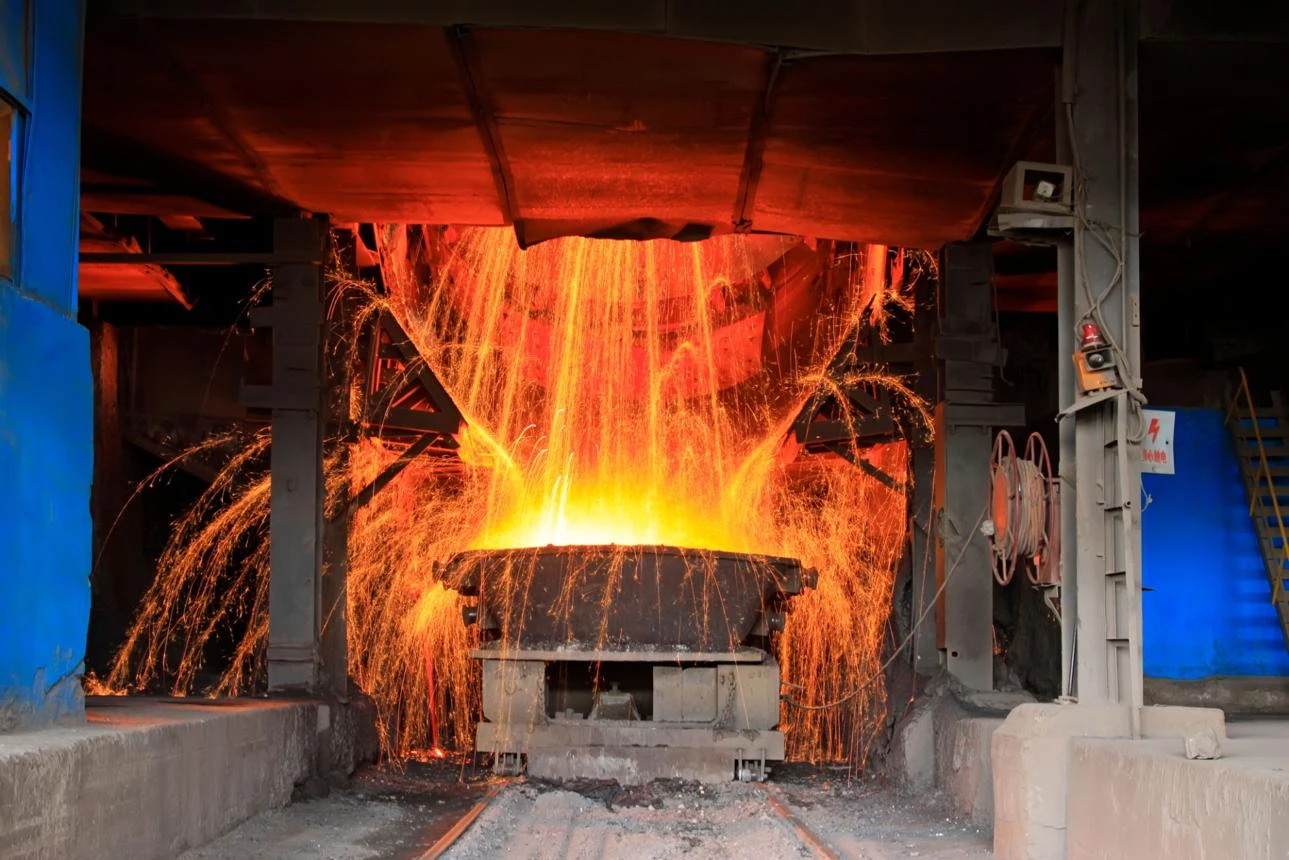
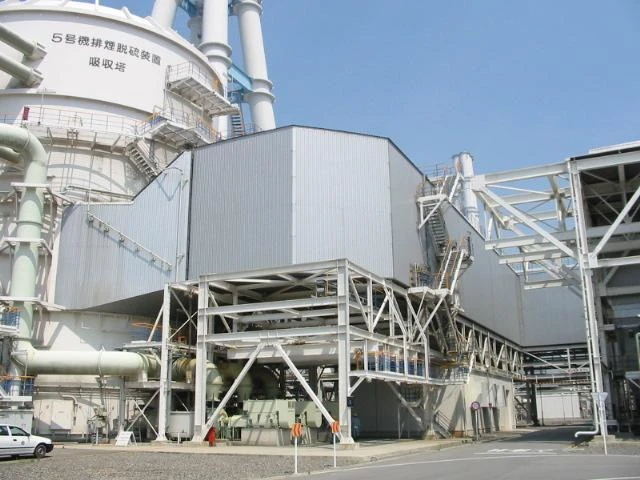
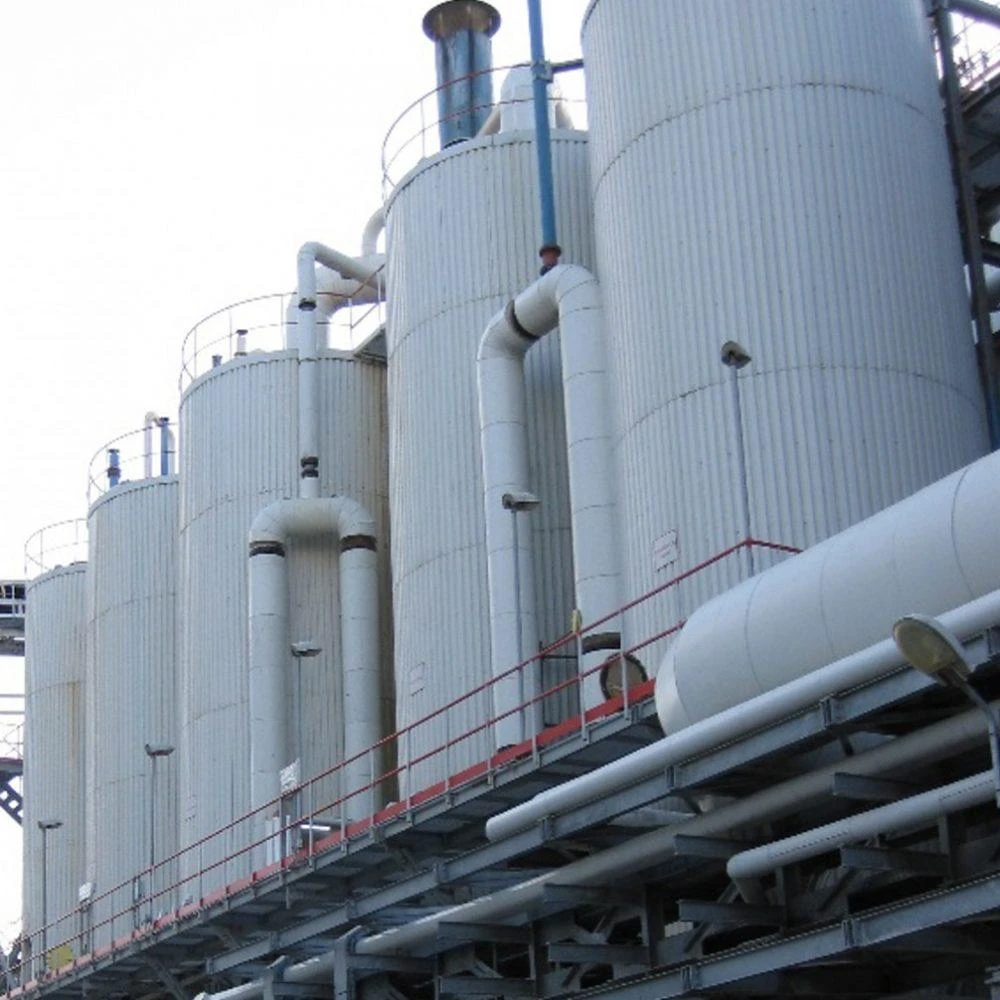
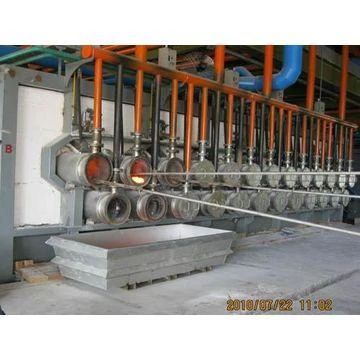
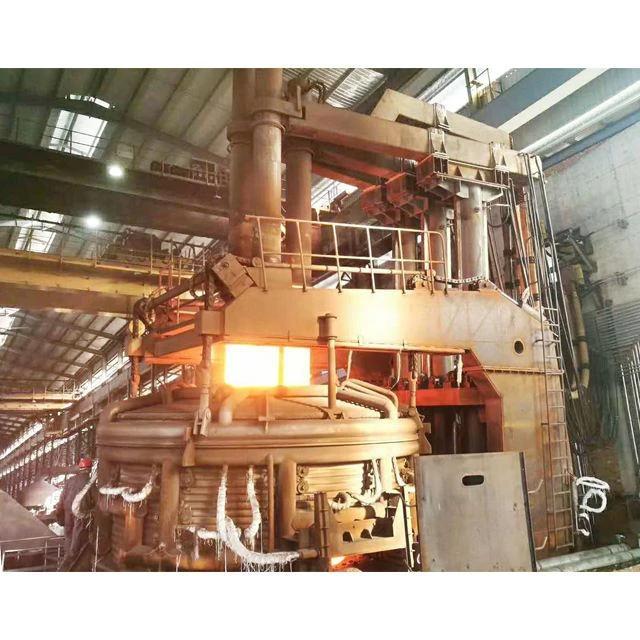
Vertical lime kilns produce quicklime and hydrated lime for industries that depend on consistent CaO quality and cost-efficient production.
How to Choose the Right Vertical Lime Kiln?
Selecting the wrong kiln size or configuration leads to wasted fuel, inconsistent lime quality, and expensive retrofits. Consider these points before requesting a quote:
For expert guidance and a project-specific kiln configuration — including material testing coordination and capacity simulation — contact Zhongyi
Request a Customized Solution
Partner with Zhongyi for expert technical support, customized solutions, and reliable equipment tailored to your ore characteristics and production requirements.
Request a Custom
To receive an accurate configuration and quotation,
Please Provide the Following Information:
Vertical Lime Kiln Manufacturer & Supplier
Zhongyi is a professional manufacturer of vertical lime kilns for the steel, chemical, sugar, and construction industries, delivering shaft kilns with daily capacities from 100 to 600 tons. A correctly specified vertical shaft kiln reduces fuel cost by 10–20% compared to rotary kilns of equivalent capacity, while requiring significantly lower maintenance due to fewer moving parts. Zhongyi evaluates your limestone composition, required capacity, fuel availability, and local emission regulations to configure the right kiln diameter, height, refractory grade, and dedusting system for each project.
We have 16+ years of engineering experience in lime calcination systems for limestone, dolomite, and chalk, Zhongyi has delivered 350+ lime kiln sets to projects across Southeast Asia, the Middle East, Africa, and Central Asia. Our ISO9001:2015 certified factory and CE-marked components ensure consistent build quality. We provide process layout design, refractory selection guidance, on-site installation supervision, operator training, and a ready stock of spare parts including grate assemblies and distributor components. For complete aggregates‑to‑fluxing loops, our design division can easily interface these thermal installations alongside multi‑stage mobile impact crusher setups.
FAQs
What is a vertical lime kiln used for?
A vertical lime kiln calcines limestone into quicklime (CaO) at 1,050–1,200 °C. It supplies lime for steelmaking slag conditioning, flue gas desulfurization, sugar refining, and chemical production.
What feed size does a vertical lime kiln accept?
Standard shaft kilns accept limestone feed of 40–80 mm. Particles below 40 mm restrict airflow; stones above 80 mm need longer residence time and reduce capacity by 15–25%.
What quicklime quality does a shaft kiln produce?
Finished quicklime typically reaches CaO content of 85–92% and activity above 300 mL (4N HCl test). Exact quality depends on limestone purity and calcination control.
How does a vertical lime kiln compare to a rotary lime kiln?
Vertical kilns use less fuel (120–140 kg coal/t vs. 150–180 kg for rotary) and have lower maintenance costs. Rotary kilns handle finer feed and offer more uniform product quality above 500 t/d.
What affects vertical lime kiln price?
Kiln diameter, fuel system type, refractory grade, environmental protection equipment, and automation level are the main cost drivers. Projects with bag filters and SCADA control cost 30–50% more than basic configurations.
How to choose a reliable lime kiln supplier?
Check ISO certification, reference projects in your industry, on-site commissioning support, and spare parts availability. Zhongyi meets all four criteria for overseas lime plant projects.
What is the typical delivery and installation time?
Equipment manufacturing takes 60–90 days depending on kiln size. On-site installation and refractory masonry require 45–90 days for a complete lime plant. Zhongyi provides installation supervision and operator training.
Does Zhongyi support customized vertical lime kiln solutions?
Yes. Zhongyi can customize kiln capacity, fuel system, automation level, environmental protection equipment, and plant layout according to project requirements, raw material conditions, and production targets. Customized solutions help match local operating conditions and long-term production needs.