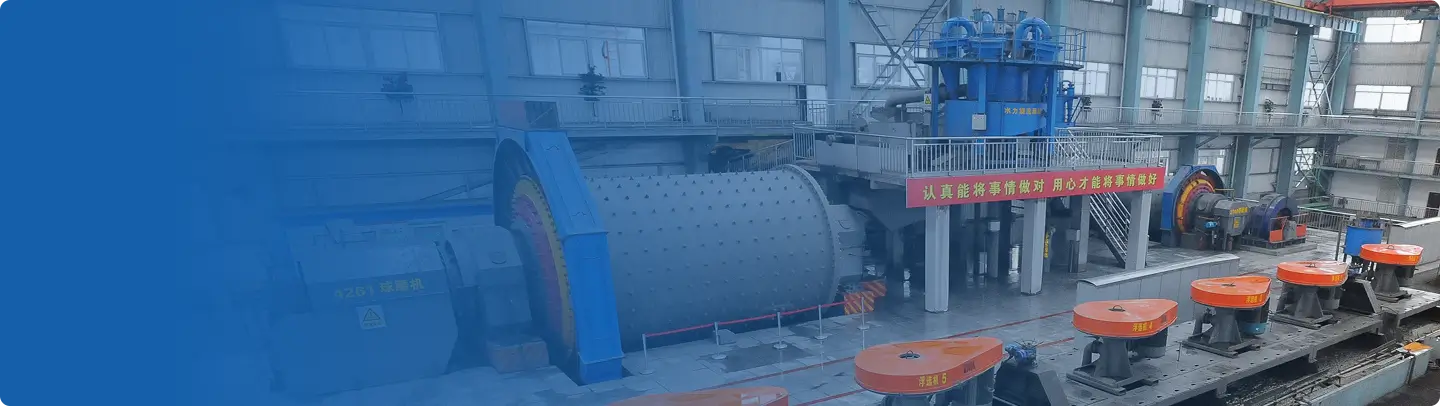
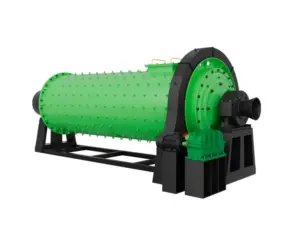
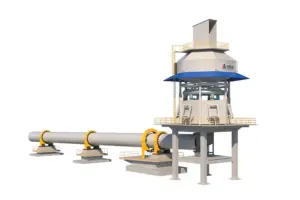
What Is a Cement Clinker Grinding Unit?
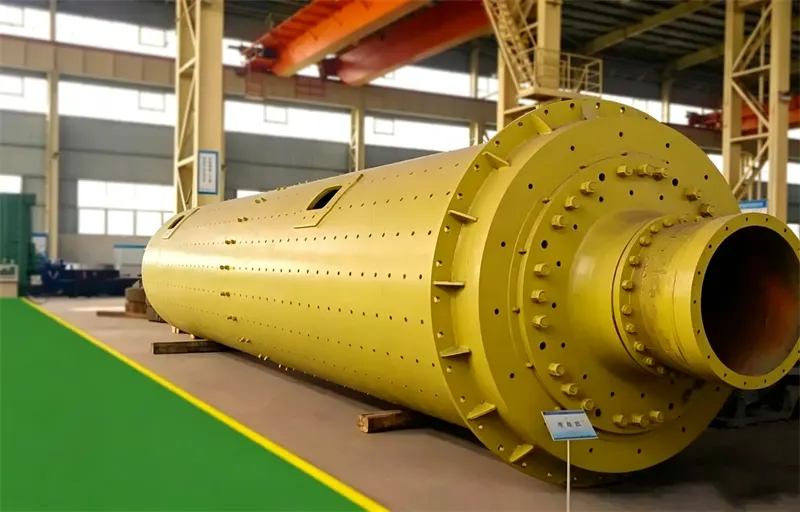
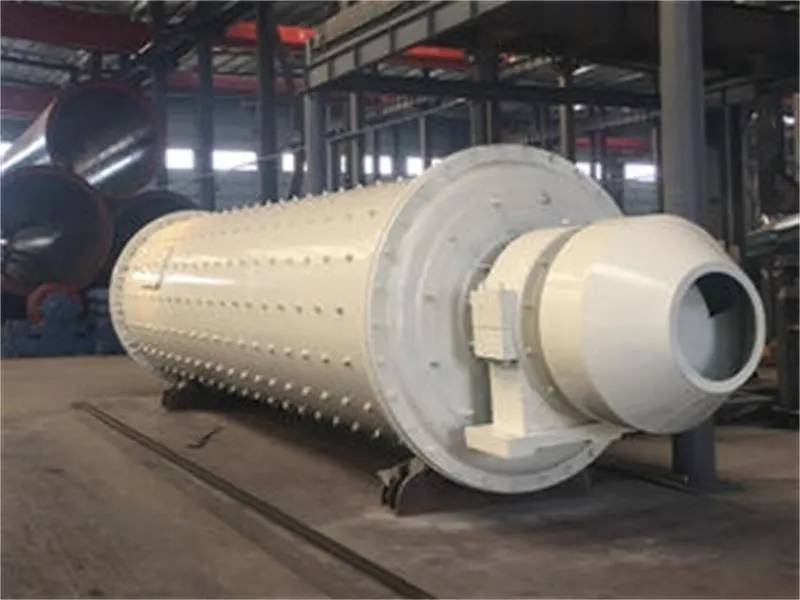
A cement clinker grinding unit, also called a clinker grinding mill, is used to grind cooled cement clinker into fine powder. It is normally installed after clinker handling and crushing equipment and works with a separator when precise fineness control is required. Depending on the cement type, gypsum and other mineral additions may be ground with the clinker or added in a downstream blending stage.
The grinding unit reduces clinker to the required fineness for cement production. Ball mills, vertical roller mills, and other grinding systems can be selected according to clinker hardness, feed size, required capacity, and target fineness. The ground material is then conveyed to the next cement processing stage.
How Does Cement Clinker Grinding Work?
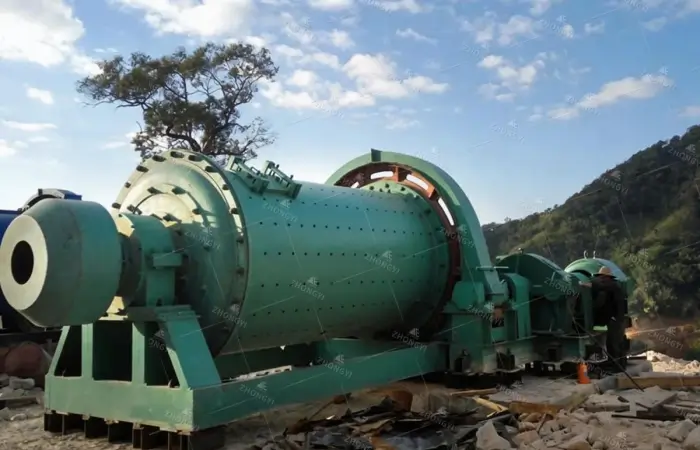
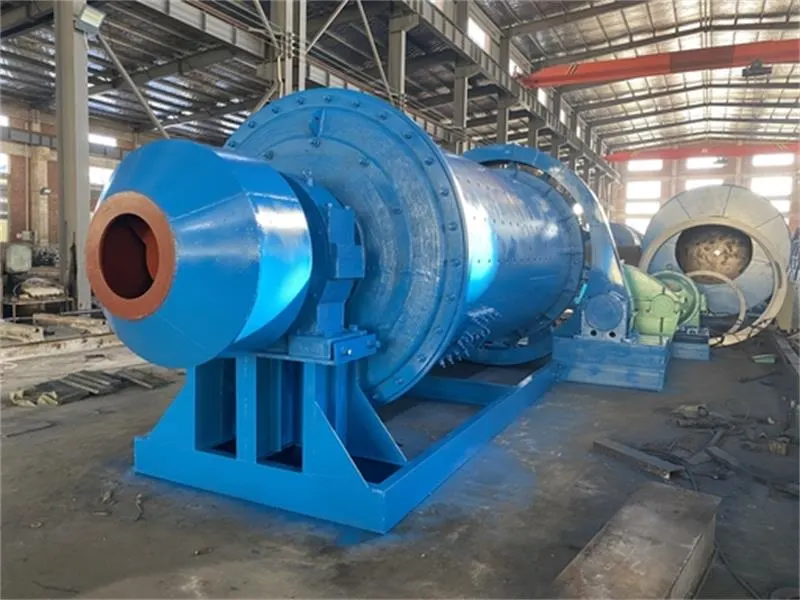
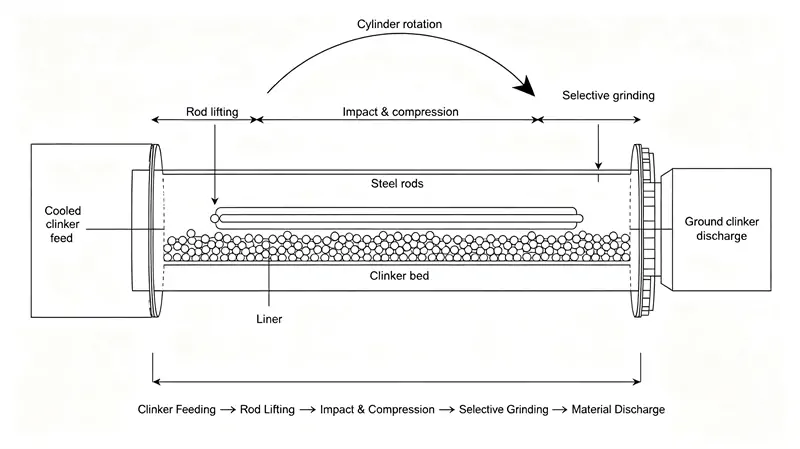
Cement clinker grinding unit uses steel rods as the grinding media to reduce cooled clinker to the target fineness. As the grinding cylinder rotates, the rods are lifted by the liner and then fall onto the clinker bed, applying impact, compression, and friction to break and grind the material. The ground clinker then moves toward the discharge end for further processing.
Feeding and Grinding
Cooled cement clinker enters the grinding chamber through the hollow feed trunnion. The motor and transmission rotate the cylinder at a controlled speed, and the liner lifts the steel rods as the cylinder turns. When the rods reach a certain height, gravity causes them to fall onto the clinker bed. Impact and compression break coarse particles, while friction between the rods and material provides additional grinding.
Selective Grinding and Discharge
The linear contact between the rods allows coarse clinker particles to be preferentially caught and crushed, while finer particles can pass through the gaps between the rods. This selective grinding helps reduce over-grinding and maintain a more uniform product size. As fresh clinker enters continuously, the ground material moves toward the discharge end and leaves the machine. Depending on the configuration, discharge can be achieved through overflow or airflow in dry grinding applications.
Grinding Process:
Clinker Feeding → Rod Lifting → Impact & Compression → Selective Grinding → Material Discharge
Cement Clinker Grinding Unit Structure
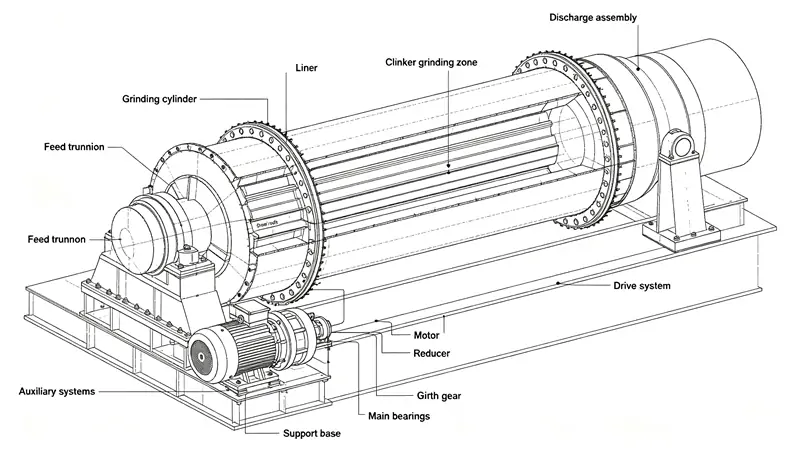
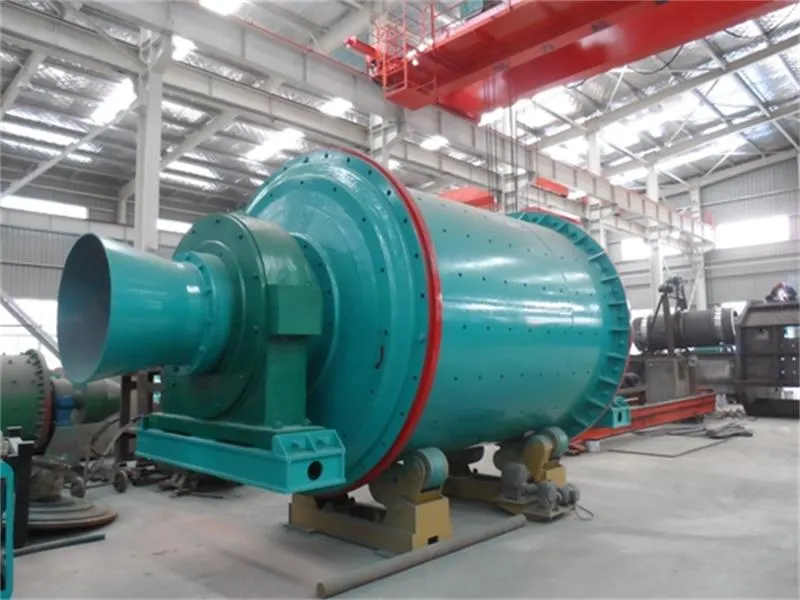
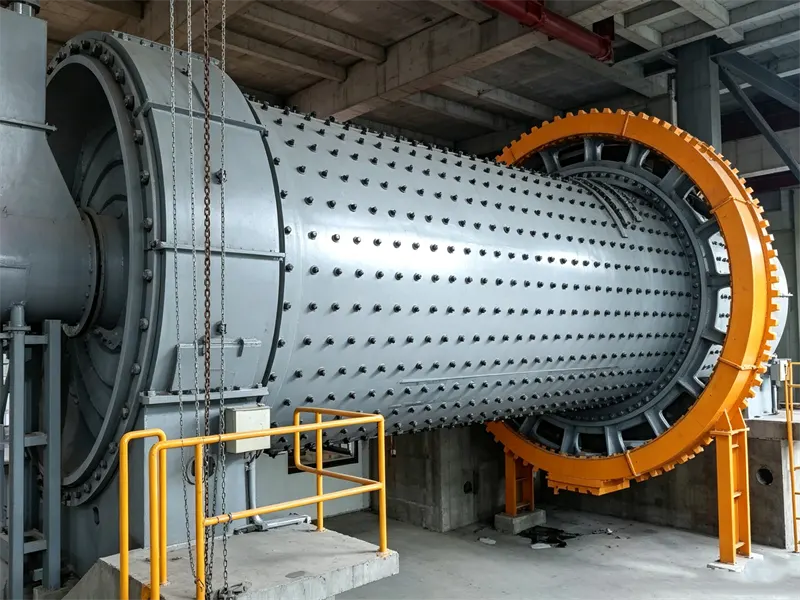
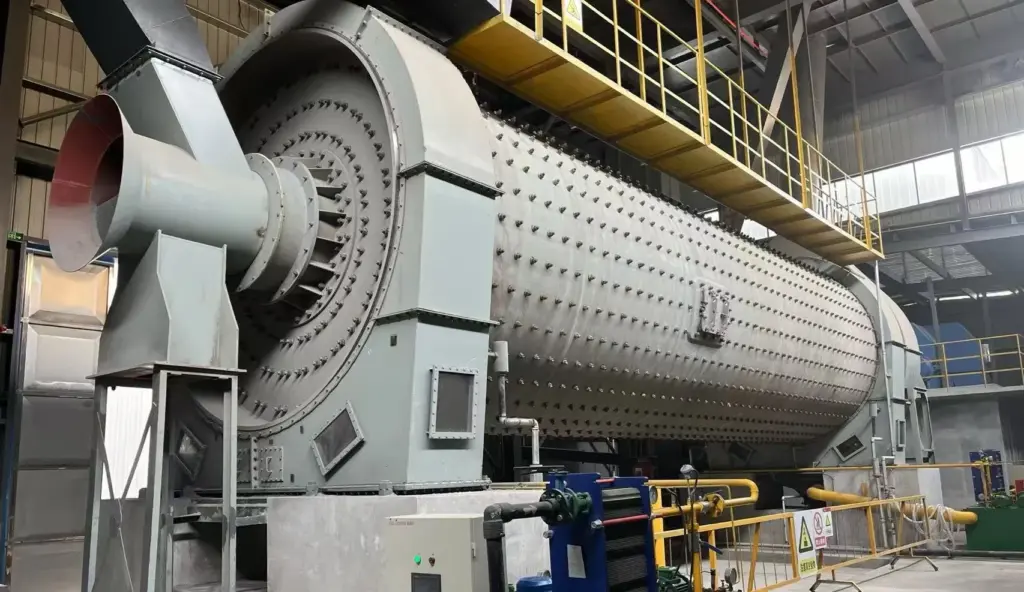
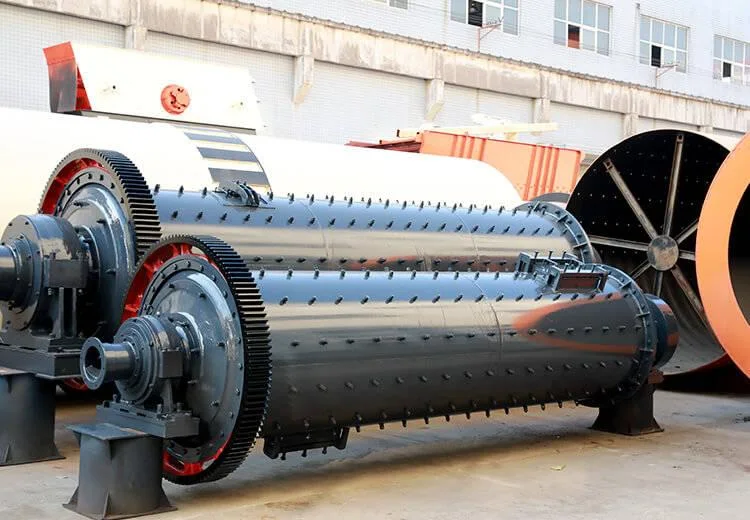
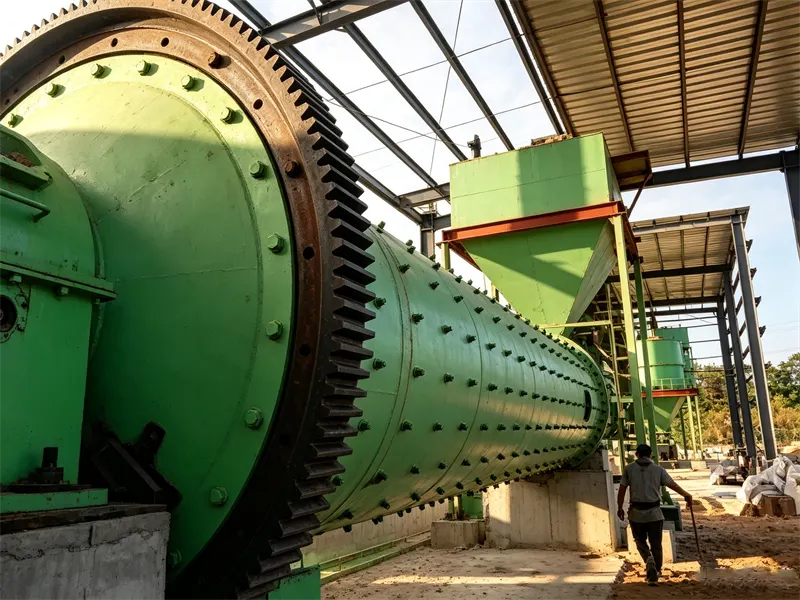
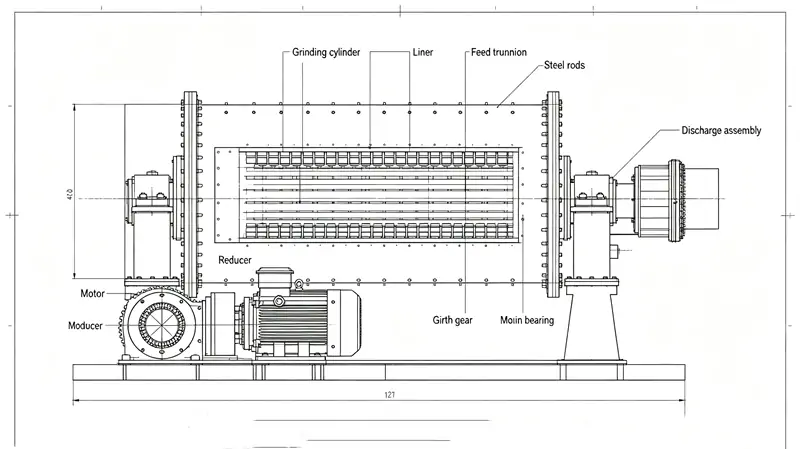
The cement clinker grinding unit is built around a horizontal grinding cylinder and steel-rod grinding media. The main components include the cylinder, liner, feed and discharge assemblies, drive system, bearings, and auxiliary systems. Each component is designed around the continuous feeding, grinding, and discharge of clinker.
- Grinding Cylinder: The main rotating body where clinker is ground. Its size and operating speed determine the available grinding space and operating conditions.
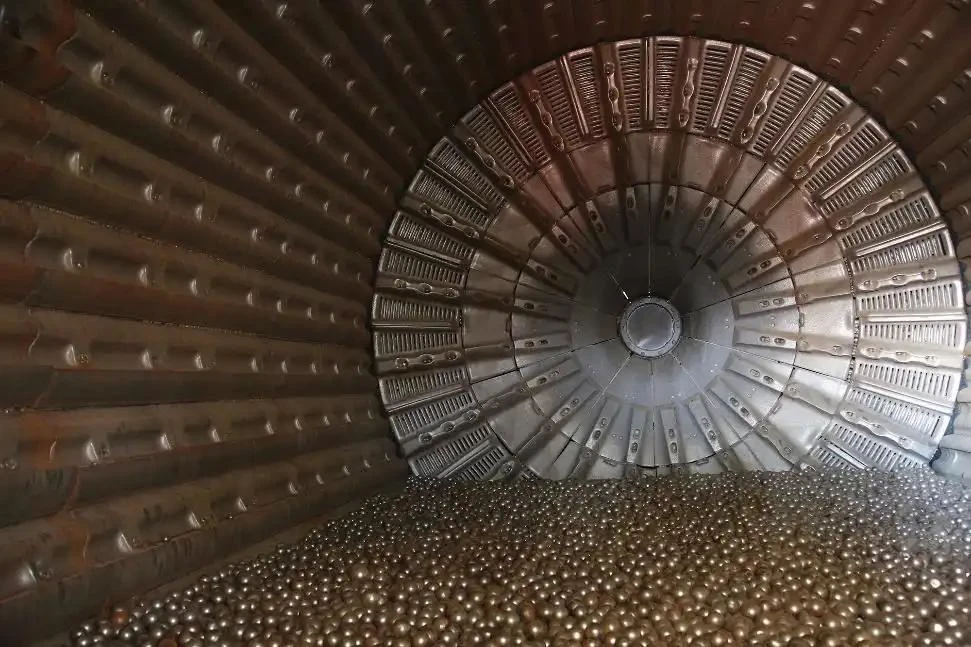
- Liner: Protects the cylinder shell from wear and lifts the steel rods as the cylinder rotates.
- Steel Rods: Act as the grinding media, applying impact, compression, and sliding action to reduce clinker particles.
- Feed Trunnion: Provides a continuous passage for cooled clinker into the grinding chamber.
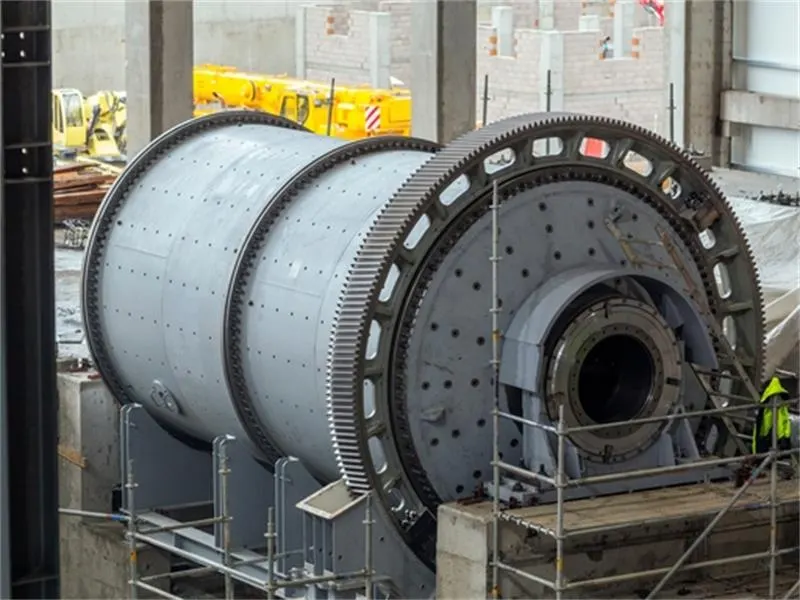
- Drive and Support System: Includes the motor, reducer, transmission components, and main bearings to rotate and support the cylinder.
- Discharge Assembly: Removes ground clinker from the discharge end after grinding. The configuration depends on the selected discharge method.
Cement Clinker Grinding Methods
Cement clinker grinding uses the combined action of impact, compression, and grinding between steel rods and clinker particles. As the cylinder rotates, the rods are lifted by the liner and then fall onto the clinker bed, breaking coarse particles and reducing their size.
The rods also slide against the clinker during rotation. Their line contact helps coarse particles receive more grinding while finer particles are less likely to remain trapped for repeated impact, helping limit over-grinding and maintain a more uniform product size.
Impact and Compression Grinding
As the cylinder rotates, the liner lifts the steel rods before gravity causes them to fall onto the clinker bed. The impact breaks coarse clinker particles, while compression between the rods and particles provides additional size reduction.
Grinding and Particle Size Control
Steel rods continuously move and slide against the clinker during operation. The line contact favors grinding of coarser particles, while finer particles are less likely to receive repeated impact. This helps reduce over-grinding and supports a more uniform product size.
What Materials Can Be Processed by the Cement Clinker Grinding Unit?
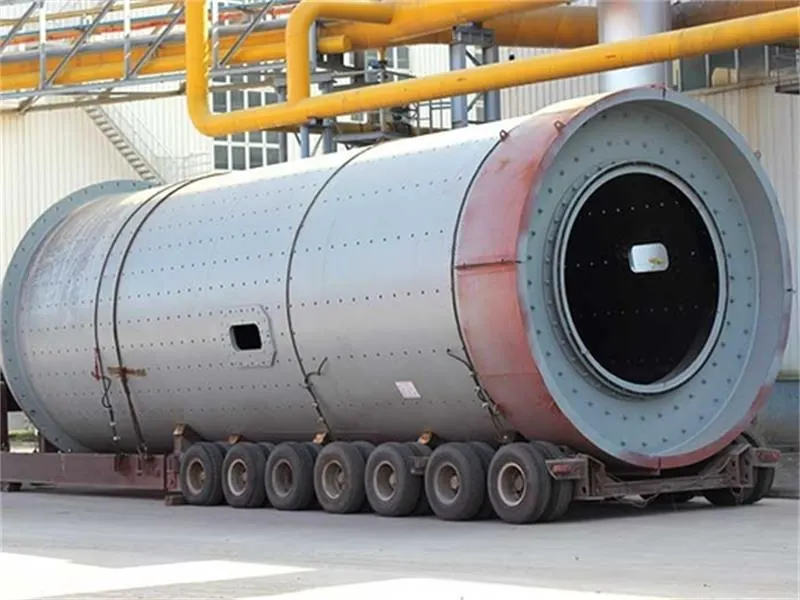
The cement clinker grinding unit machine is primarily designed for cooled cement clinker. It can also be considered for other mineral materials such as limestone, gypsum, and slag when their feed size, hardness, moisture, and required product size are within the operating range of the selected mill.
Cement Clinker
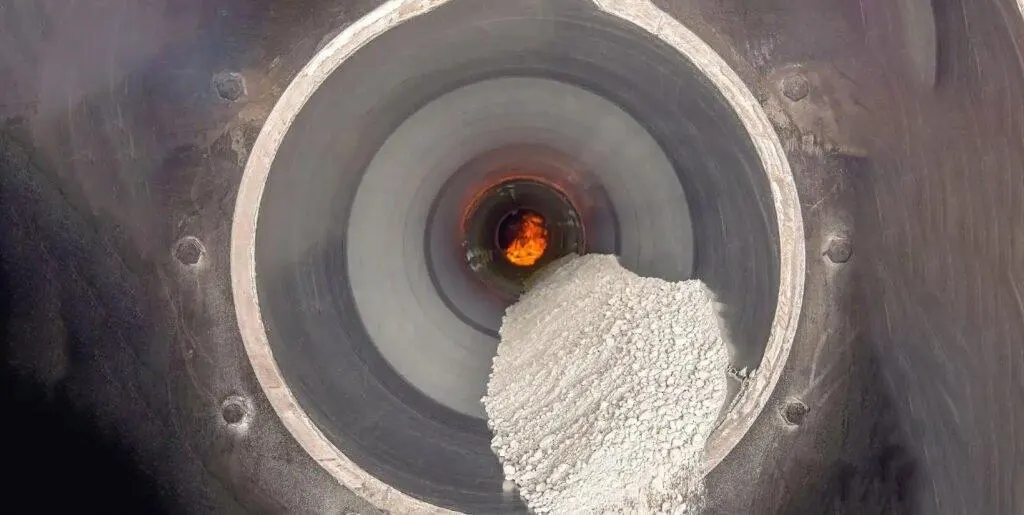
Cement clinker is the main material processed by this machine. The steel-rod grinding system is used to reduce cooled clinker to the required product size while limiting excessive fine generation.
For limestone, gypsum, slag, fly ash, or other non-metallic minerals, equipment selection should be based on the actual material properties and grinding requirements. Feed size, hardness, moisture, required fineness, and required capacity should be confirmed before selecting the mill model.
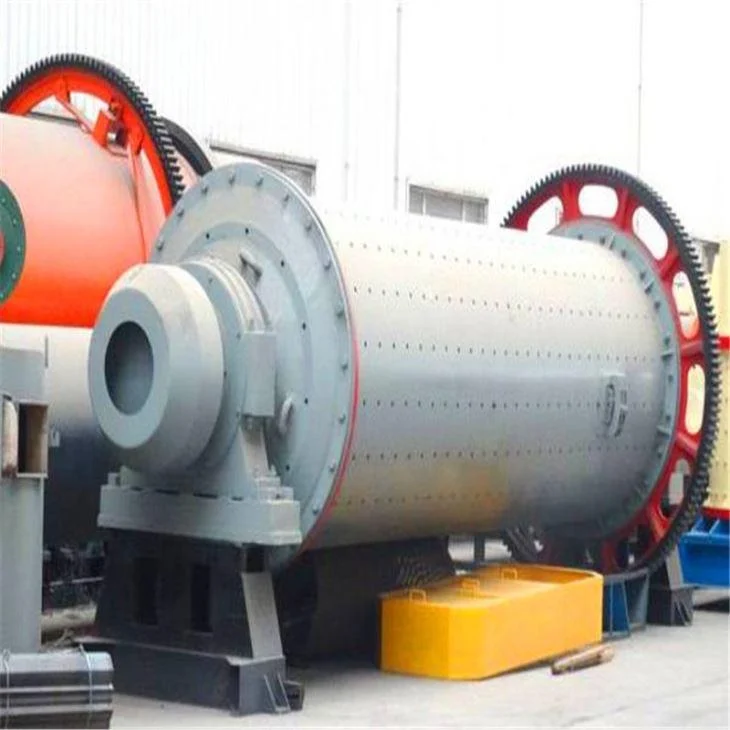
Cement Clinker Grinding Specifications
The Cement Clinker Grinding machine is equipped with high-chrome alloy steel rods for clinker grinding. The following are the main operating parameters and applicable conditions.
| Parameter | Specification |
| Feed Size | ≤20–25 mm |
| Product Size | 0.074–0.8 mm |
| Grinding Media | High-Chrome Alloy Steel Rods |
| Grinding Method | Dry / Wet Grinding |
| Circuit | Open Circuit / Closed Circuit |
| Applicable Materials | Cement Clinker, Slag, Limestone |
Cement Clinker Grinding Performance
The cement clinker grinding unit machine uses high-chrome alloy steel rods as grinding media. The grinding result depends on clinker feed size and hardness, rod loading, mill speed, and feed rate.
Selective Grinding and Product Size Control
The steel rods provide line contact with clinker particles during operation. Coarse particles receive impact and compression, while finer particles are less likely to receive repeated impact. This helps limit excessive fine generation.
Product size can be adjusted through rod loading, mill speed, feed rate, and other operating parameters. For closed-circuit grinding, a separator can return coarse material to the mill for further grinding and provide additional control of the final product size.
Continuous Operation and Wear Parts
The machine supports continuous feeding and discharge during normal operation. Cooled clinker enters through the feed end and ground material is discharged through the outlet. For dry clinker grinding, the discharge system can be connected to dust collection equipment.
The grinding chamber is protected by wear-resistant liners. Steel rods and liners are replaceable wear parts and should be inspected periodically according to operating conditions.
Cement Clinker Grinding Applications
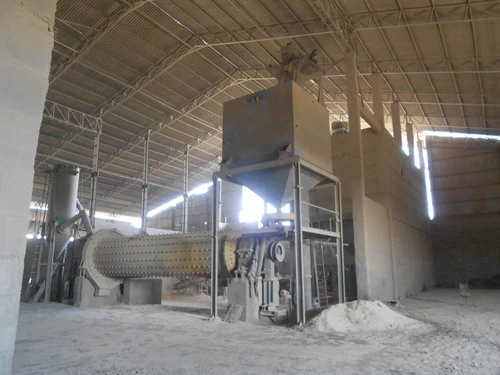
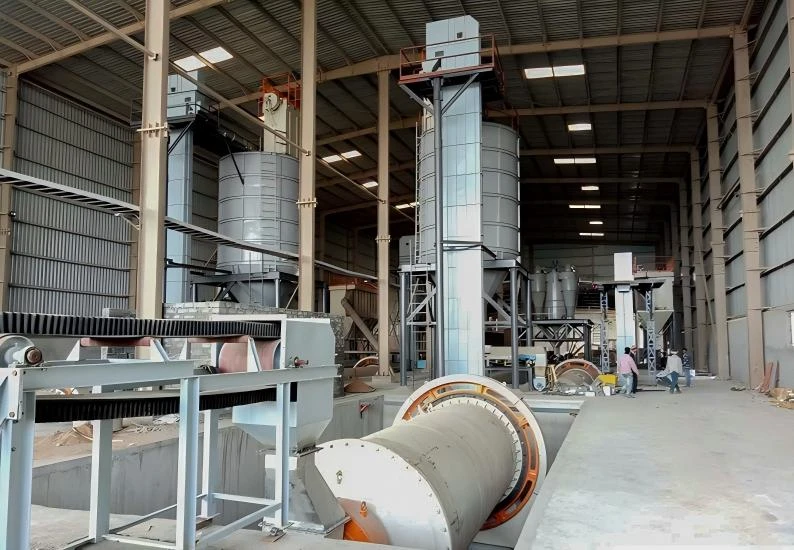
The Cement Clinker Grinding machine is primarily used to grind cooled cement clinker to the required product size for cement production and independent clinker grinding operations. The machine can be used in dry grinding applications and configured for open- or closed-circuit operation according to the required grinding conditions.
How to Choose a Cement Clinker Grinding Unit?
In actual clinker grinding projects, capacity alone is not enough to select a mill. We normally look at the clinker properties, feed condition, required fineness, and operating environment together. Two projects with the same capacity may require different mill specifications if the clinker hardness, feed size, or final fineness is different.
Start with the Material, Then Match the Capacity
First, confirm the maximum clinker feed size, hardness or grindability, and moisture content. These parameters determine how much grinding work the mill needs to handle. In our experience, feed size and clinker grindability are particularly important when comparing different projects, because they can affect actual throughput, motor load, and wear of the rods and liners.
Next, define the required capacity in t/h or t/day. We recommend using the normal continuous production requirement rather than a short-term peak value. The capacity should be considered together with the material properties instead of being used as the only basis for selecting the mill model.
Match the Mill to the Final Product
The required product fineness should be confirmed before the equipment is selected. Depending on the cement specification, the target may be expressed by Blaine value, sieve residue, or particle size. A finer grinding requirement changes the operating conditions and may affect the selected mill size and grinding configuration.
The grinding circuit should also be considered. For some applications, an open-circuit arrangement is sufficient; where tighter control of product fineness is required, a closed-circuit arrangement with downstream separation can be considered.
Check the Actual Site Conditions
The last step is to check the conditions around the mill. Power supply, working hours, ambient conditions, and existing feeding, conveying, separation, and dust collection equipment all need to match the selected machine.
For each project, we use these parameters to check the cylinder size, rod load, motor power, and supporting equipment before recommending a model. This helps ensure that the selected cement clinker grinding unit is based on the customer’s actual clinker and production requirements, rather than simply choosing a larger machine from a capacity table.
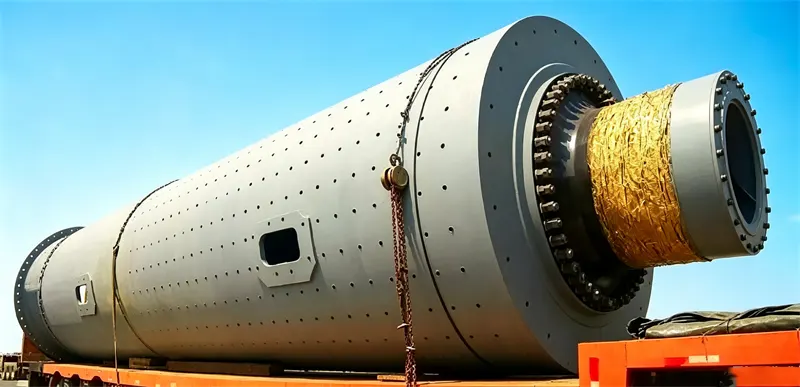
Cement Clinker Grinding Unit vs. Ordinary Grinding Mill
Cement clinker is not handled in exactly the same way as general mineral materials. It is a calcined, relatively hard and abrasive material, and the grinding target is closely related to the performance of the final cement. For this reason, selecting a grinding machine for clinker requires more than simply comparing the rated capacity of different mills.
| Factor | Clinker Grinding | General Mineral Grinding |
| Material | Cooled cement clinker | Different minerals with varying properties |
| Hardness & Abrasion | Hard and abrasive; wear needs close attention | Depends on the mineral |
| Feed Condition | Feed size and clinker grindability affect mill load | Varies with the material and process |
| Fineness | Closely related to cement performance | Determined mainly by the end application |
| Moisture | Important for dry grinding and material flow | Depends on the material and process |
| Wear Parts | Rods and liners require regular inspection | Wear rate varies with material hardness |
| Grinding Circuit | Open or closed circuit can be selected according to fineness requirements | Depends on the required product size and process |
| Process Control | Capacity, fineness, feed rate, and mill load need to be kept within the selected operating range | Control requirements depend on the material |
Cement Clinker Grinding Unit Maintenance and Wear Parts
The liners and steel rods are the main wear parts inside the grinding chamber. The liners protect the cylinder and help lift the rods during rotation, while the rods provide the grinding action on the clinker. Since cement clinker is hard and abrasive, these parts gradually wear during operation. Inspection should focus on liner wear or damage and the condition, diameter loss, bending, or breakage of the steel rods.
Routine maintenance also covers the bearings, drive system, lubrication, and feed and discharge areas. Check for abnormal vibration, temperature, noise, lubrication condition, material buildup, or unstable discharge during operation. Wear-part replacement should be based on actual operating conditions rather than a fixed service interval, as clinker hardness, feed size, throughput, and working hours all affect wear. When ordering replacements, confirm the mill model, cylinder size, liner specification, and rod size to ensure proper fit.
Why Choose Zhongyi Mining for Cement Clinker Grinding?
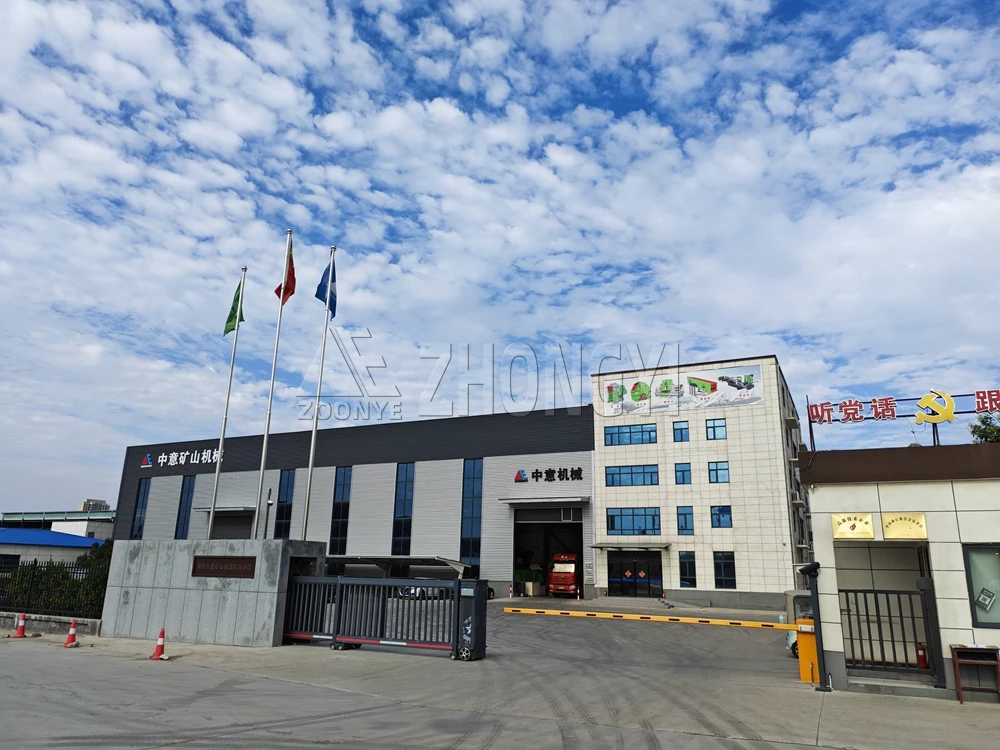
Zhongyi Mining has been manufacturing industrial equipment since 2010, with a 40,000+ m² manufacturing facility and in-house capabilities covering equipment design, fabrication, assembly, inspection, and testing. For cement clinker grinding, our engineers consider clinker properties, feed size, required capacity, product fineness, and site conditions when selecting the equipment and configuration.
Equipment design includes ANSYS finite element analysis (FEA) for structural checks, while manufacturing follows inspection and traceability procedures from components through assembly. Factory testing can include 4-hour no-load operation, vibration monitoring at ≤4.5 mm/s, temperature-rise checks at ≤45°C, and 120% rated-load testing with transmission efficiency ≥95%, according to the applicable equipment testing requirements.
For the project itself, we can support material assessment, equipment selection, process arrangement, installation, commissioning, operator training, and spare parts supply. This gives customers a single engineering contact from equipment selection through site commissioning and subsequent technical support, rather than simply supplying the grinding machine.
Request a Customized Solution
Partner with Zhongyi for cement clinker grinding unit designed for reducing cooled cement clinker to the required fineness in cement production and independent clinker grinding applications. The machine is selected according to clinker feed size, hardness, capacity, target fineness, and operating conditions.
Custom High Density Agitation Tank Solutions
Every Cement Clinker Grinding project has different requirements for capacity, clinker properties, feed size, product fineness, and existing equipment. Tell us your material conditions, production target, site requirements, and any equipment already in place. Our engineers can then match the grinding machine and supporting equipment to your process. If you are planning a complete cement processing system, you can also explore our [Calcination Plant Solutions] for related process configurations. For your specific clinker grinding requirements, contact Zhongyi with your project details and we will help you work out a suitable equipment configuration.
Please Provide the Following Information:
FAQs
How do I select the right cement clinker grinding unit machine?
Model selection should consider more than the required capacity. We normally check clinker hardness or grindability, maximum feed size, required capacity, target fineness, moisture content, and site conditions. These factors affect the cylinder size, rod loading, and motor power. If representative clinker or test data is available, it can help us select a model based on actual material behavior rather than capacity alone.
What capacity can a cement clinker grinding machine handle?
The capacity depends on the selected mill model and the actual clinker grinding conditions. For the MBS series, the listed clinker capacity ranges from 0.62 to 92 t/h across different models. Actual throughput can vary with clinker hardness, feed size, required fineness, rod loading, and operating conditions. Capacity should therefore be confirmed together with the material and product requirements before selecting a specific model.
What feed size is suitable for cement clinker grinding?
The suitable feed size depends on the selected mill model and grinding conditions. Oversized clinker can increase the grinding load and affect throughput. Before selecting a model, provide the maximum feed particle size together with the required capacity. We use these values, along with clinker hardness and target fineness, to determine a suitable cylinder size, rod loading, and motor power.
What fineness can be achieved by cement clinker grinding?
The achievable fineness depends on clinker properties, feed size, mill speed, rod loading, feed rate, and grinding circuit. The required product can be specified by Blaine value, sieve residue, mesh, or particle size, depending on the cement specification. We recommend confirming the fineness target before equipment selection because the required grinding conditions and circuit arrangement may change with the final product requirement.
Does clinker hardness affect grinding capacity?
Yes. Clinker hardness and grindability can affect throughput, motor load, and wear of the rods and liners. Two clinker materials with the same feed size and capacity requirement may therefore require different operating conditions or mill specifications. When selecting a machine, we recommend providing representative clinker data or a material sample whenever possible, particularly when the material properties are not yet well established.
What grinding media are used for cement clinker grinding?
The machine uses steel rods as the grinding media. During cylinder rotation, the liner lifts the rods before they fall onto the clinker bed, producing impact and compression while the moving rods also grind the particles through contact. Rod size, loading, and condition should be matched to the selected model. During operation, rods should be inspected for excessive wear, bending, or breakage.
Can a cement clinker grinding unit use an open or closed circuit?
Both configurations can be considered according to the required fineness and process arrangement. Open-circuit grinding discharges material after the grinding stage, while closed-circuit grinding uses downstream classification and returns coarse material for further grinding. The suitable arrangement depends on the target product, required capacity, and existing equipment. It should be confirmed as part of the overall grinding system design.
What maintenance is required for a cement clinker grinding unit?
Routine maintenance focuses on the liners, steel rods, bearings, drive system, lubrication, and feed and discharge areas. Operators should watch for abnormal vibration, temperature, noise, material buildup, and excessive wear. Inspection intervals depend on clinker hardness, feed size, throughput, and working hours. When ordering replacement parts, confirm the mill model, cylinder size, liner specification, and rod size to ensure proper fit.