What Is a Triple Shaft Horizontal Vibrating Screen?
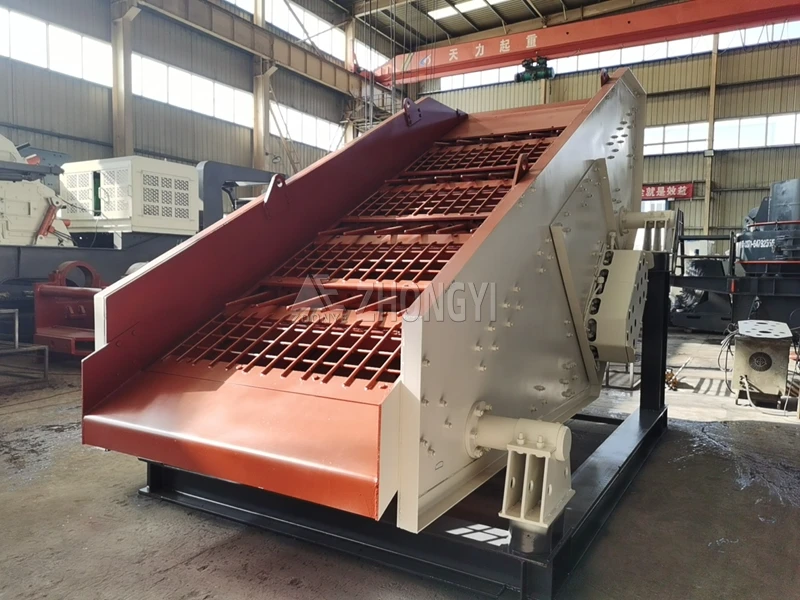
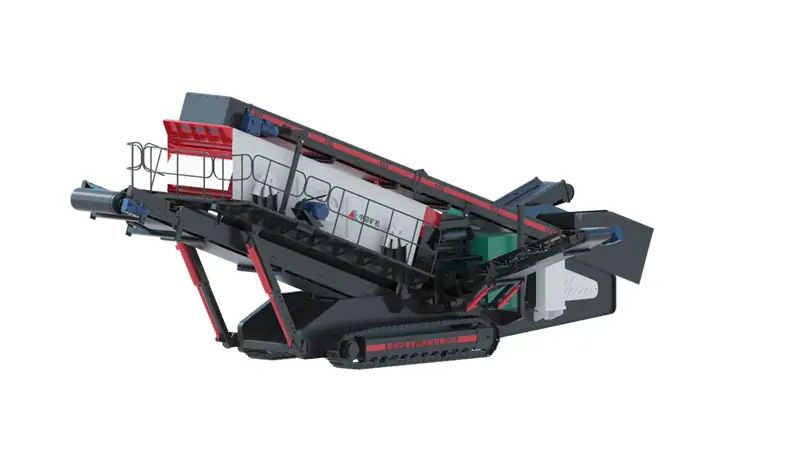
A Triple Shaft Horizontal Vibrating Screen, also known as a triple shaft horizontal screen or triple shaft vibrating screen, is a horizontal screening machine used to separate bulk materials by particle size. It uses three synchronized shafts to generate elliptical motion across the screen deck, promoting material stratification and allowing undersize particles to pass through the screen openings while oversize material continues toward the discharge end. With multiple deck configurations available, it can perform several size classifications within one machine.
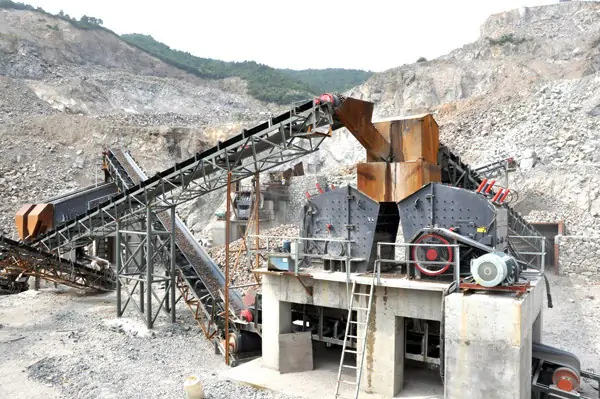
In a processing plant, the screen is typically installed downstream of crushing equipment, feeders or washing systems and upstream of stockpiling, conveying or further processing equipment. It can be used for crushed ore, aggregates, coal and recycled materials, with screen media and aperture selected according to feed size, moisture and required cut points. For example, a three-deck configuration can produce multiple size fractions in a single screening stage.
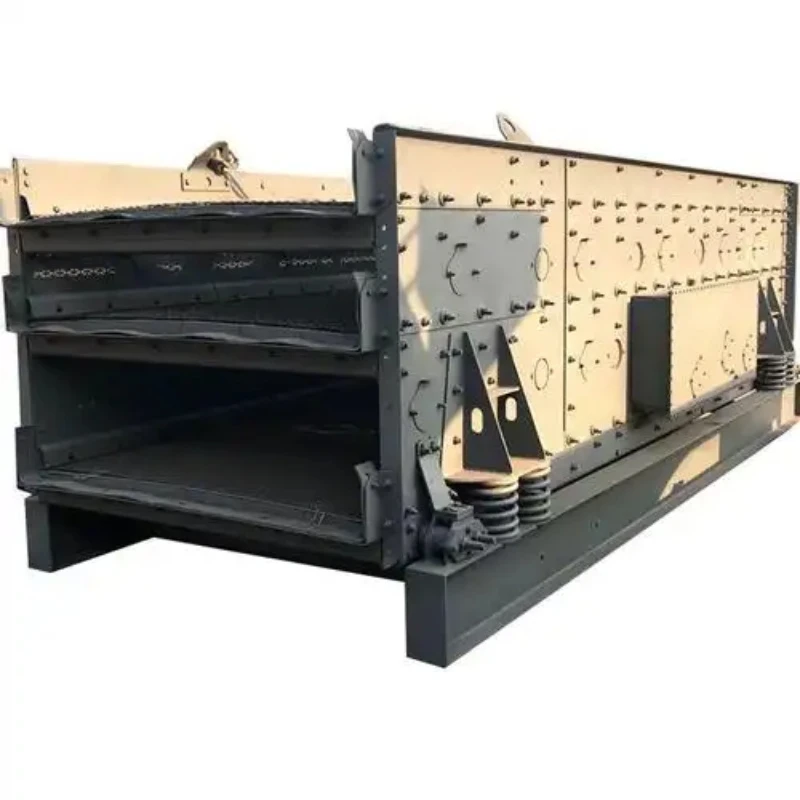
How Does a Triple Shaft Horizontal Vibrating Screen Work?
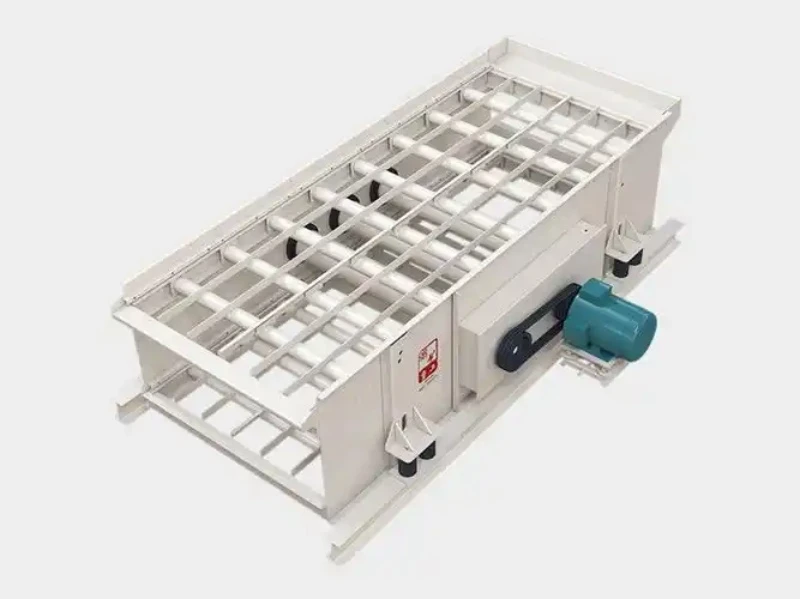
A Triple Shaft Horizontal Vibrating Screen uses three synchronized eccentric shafts to generate a controlled elliptical motion of the screen box. The combined excitation moves the material across the screen surface while promoting stratification and particle penetration through the apertures. Stroke, shaft speed, screen inclination and feed conditions all affect material travel and screening performance.
Three-Shaft Excitation and Elliptical Motion
The drive motor transmits power to the excitation system through a belt drive, while gears synchronize the three shafts at the same rotational speed. The eccentric arrangement of the shafts generates coordinated excitation forces that drive the screen box in an elliptical path. Compared with a simple linear motion, this movement combines screening and material conveying in the same operation, making the screen suitable for high-throughput applications.
Material Stratification and Particle Separation
As material enters the deck, the elliptical motion moves and lifts the bed while smaller particles migrate toward the screen surface. Particles smaller than the selected aperture pass through the media, while oversize material continues toward the discharge end. Stroke and speed affect how quickly material travels across the deck, while feed rate, moisture and bed depth determine how much opportunity particles have to pass through the openings. Multi-deck configurations can separate several size fractions in one screening stage.
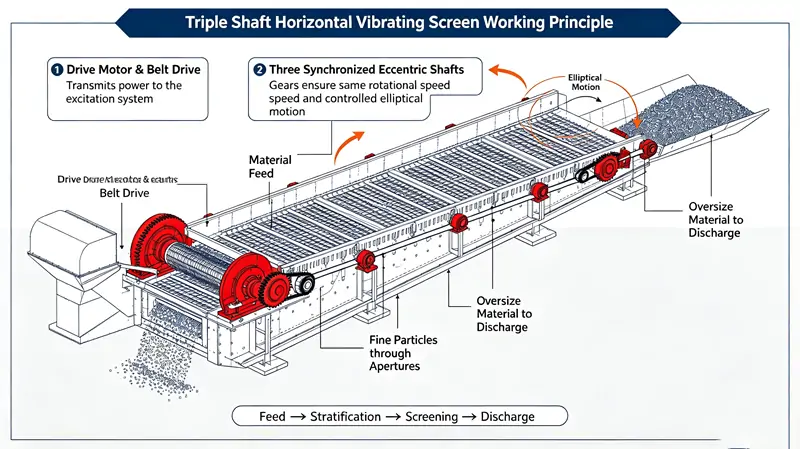
Triple Shaft Horizontal Screen Structure
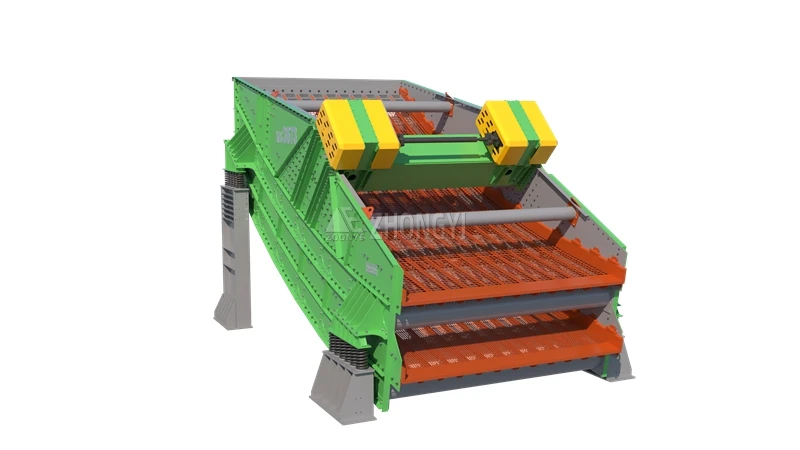
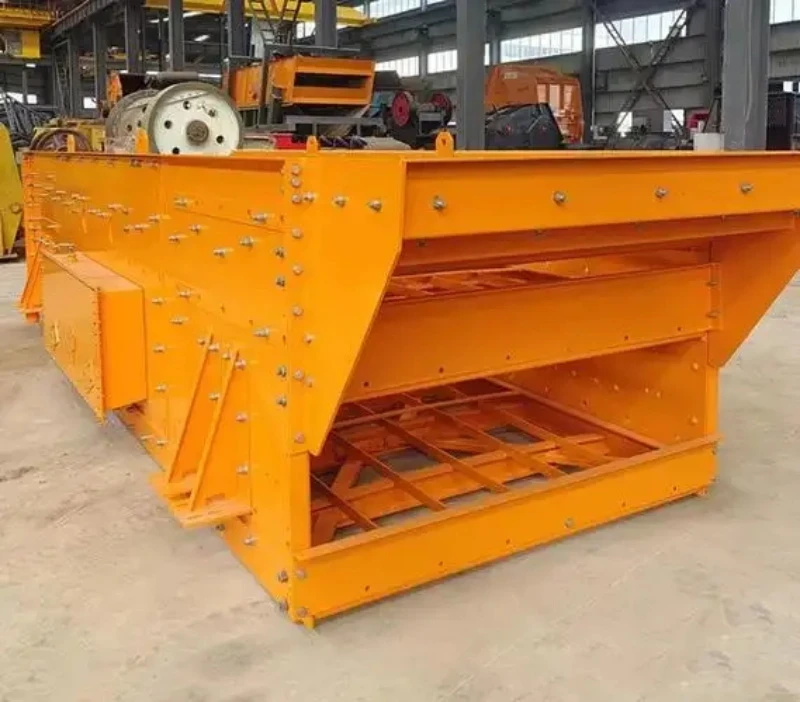
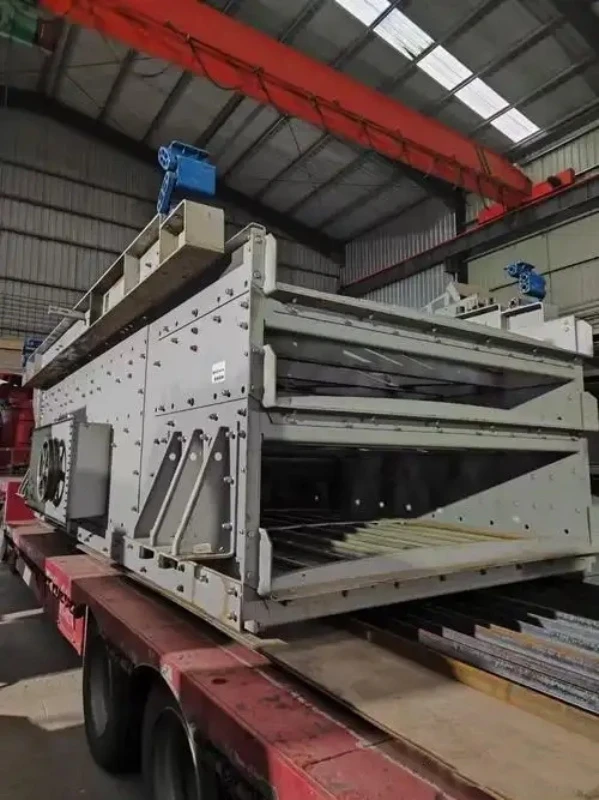
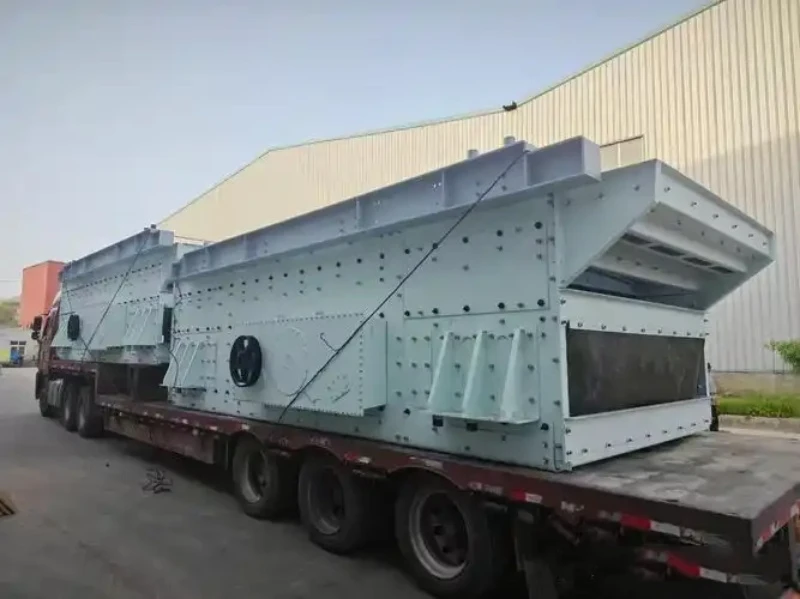
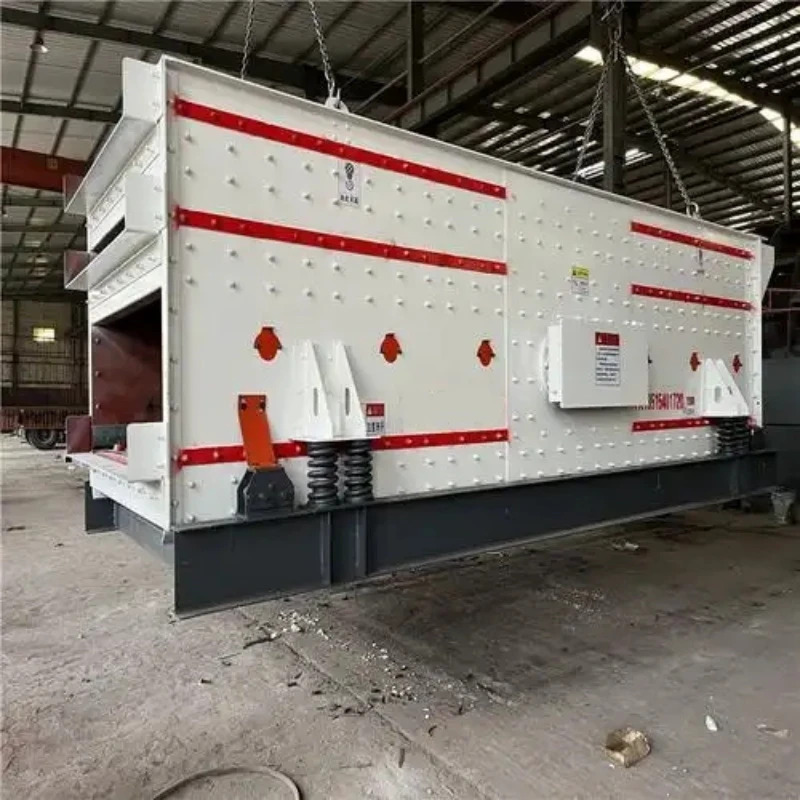
A triple shaft horizontal screen consists of the screen box, triple-shaft excitation system, screen deck, support system and drive assembly. The three parallel shafts work through synchronized gearing to generate the required elliptical motion, while the screen box and support components withstand the repeated dynamic load. Screen media, deck arrangement and drive components can be selected according to feed material, required cut sizes and operating conditions.
- Screen Box: Consists of side plates, cross members and deck supports, forming the main load-bearing structure for the screening decks.
- Triple-Shaft Excitation System: Consists of three eccentric shafts, synchronization gears and bearings to generate and transfer the screening motion.
- Screen Deck and Media: Consists of screen panels or mesh in different materials and apertures to separate particles by size.
- Spring Suspension and Support: Consists of support springs and mounting components to carry the vibrating screen box and isolate dynamic loads.
- Drive and Lubrication System: Consists of the motor, belt drive, bearings and lubrication points to provide power and support continuous operation.
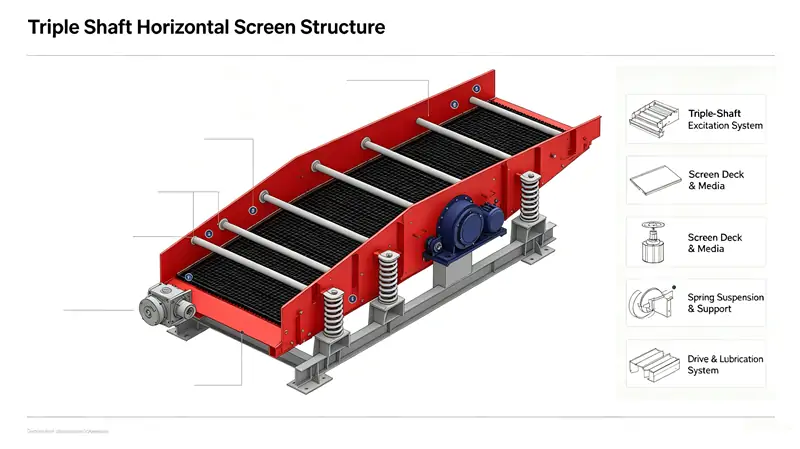
Advantages of Triple Shaft Horizontal Screens
The main advantages of a triple shaft horizontal screen come from the interaction between its three-shaft excitation system, elliptical motion and flexible screen configuration. These features allow the equipment to control material movement, maintain effective particle separation and adapt to different feed and product requirements.
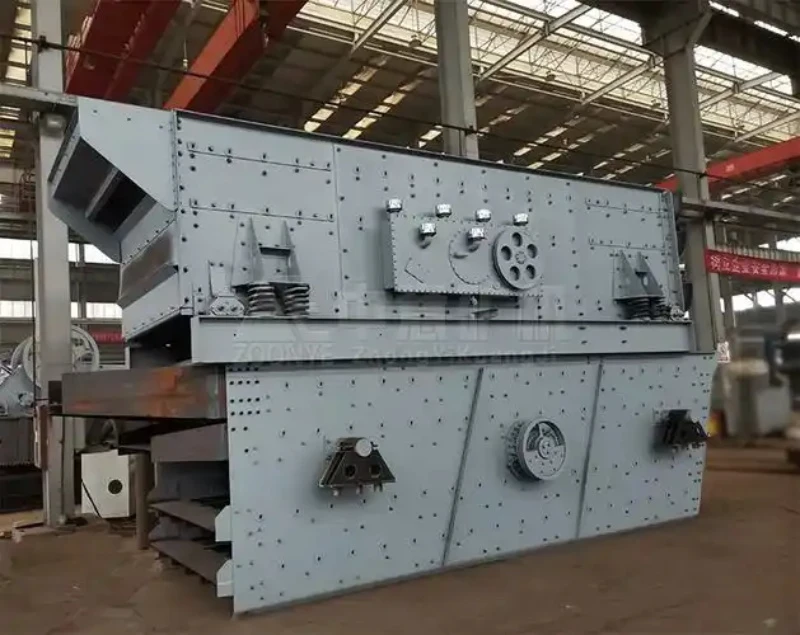
Materials Suitable for Triple Shaft Horizontal Screens
Triple shaft horizontal screens handle bulk materials such as crushed rock, gravel, sand, coal, iron ore, copper ore and recycled aggregates. Selection depends on feed size, fines, moisture, clay content and abrasiveness, with screen media and deck arrangement matched to the required cut sizes.
| Material | Typical Screening Duty |
| Crushed Rock | Separation into aggregate size fractions after crushing |
| Gravel & Sand | Sizing and grading for aggregate production |
| Iron Ore | Feed sizing and classification before downstream processing |
| Copper Ore | Particle-size classification in mineral processing circuits |
| Coal | Separation of different coal size fractions |
| Recycled Aggregates | Classification of crushed concrete and mixed recycled materials |
| Construction Materials | Size separation before conveying, stockpiling or further processing |
Triple Shaft Horizontal Vibrating Screen Applications
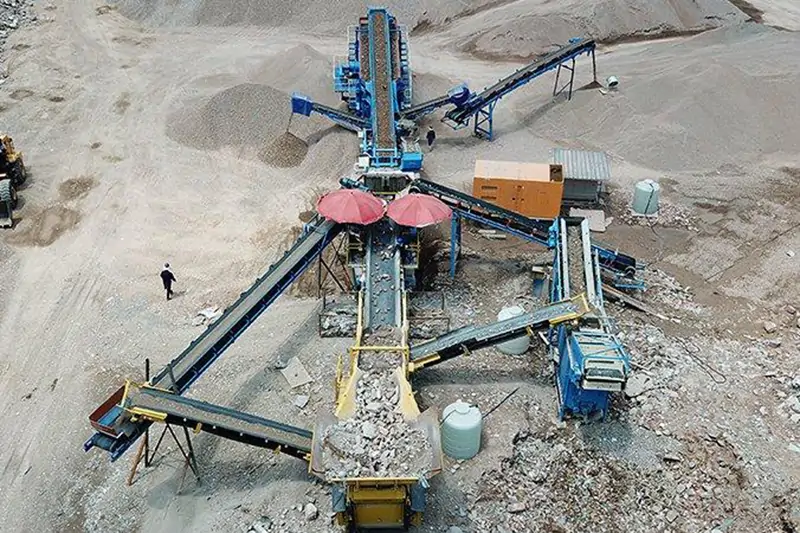
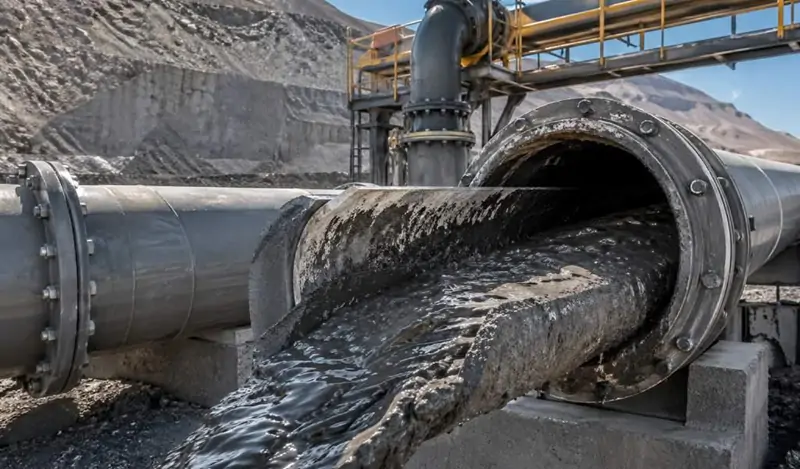
A triple shaft horizontal vibrating screen is used for size separation and material classification across aggregate, mining, recycling and wet screening operations.
How to Select a Triple Shaft Horizontal Vibrating Screen?
A suitable triple shaft horizontal screen is not selected by capacity alone. Feed behavior, separation targets and plant layout all affect the screen size, deck arrangement and media selection.
Match the Screen to Feed Behavior
Start with feed rate, maximum particle size, bulk density, moisture and abrasiveness. For sticky, wet or highly abrasive feed, the screen media and operating configuration need to be considered together rather than selecting the machine from capacity alone.
Build the Deck Around the Product
Define the required cut sizes and number of final fractions first. The aperture sequence, deck number and screen media can then be arranged around the actual products, such as 0–5 mm, 5–10 mm and 10–20 mm, instead of using a standard deck layout.
Check the Machine Against the Plant
Confirm the available footprint, feed and discharge positions, support structure, power supply and maintenance access. For an existing crushing or washing line, these conditions should be checked before finalizing the screen dimensions and configuration.
Triple Shaft Horizontal Screen Specifications
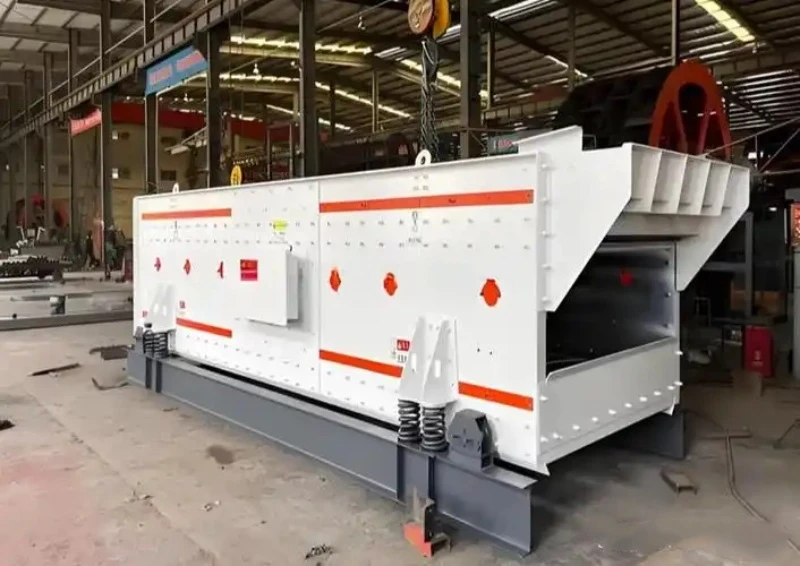
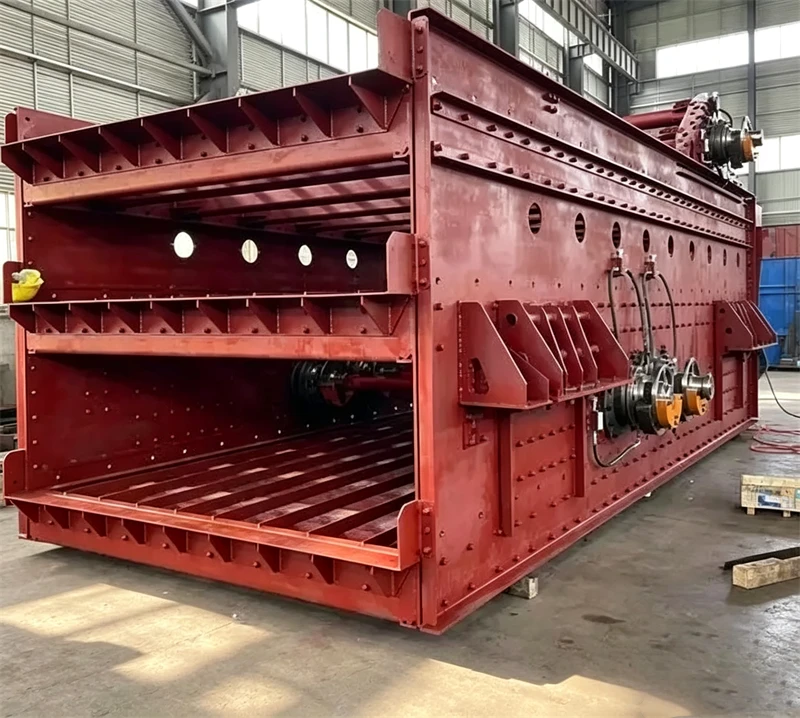
The table below lists the main configuration parameters for triple shaft horizontal screens, covering the excitation system, screen decks, media and operating mode.
| Parameter | Specification / Configuration |
| Screen Type | Triple Shaft Horizontal Vibrating Screen |
| Excitation | Triple Eccentric Shafts |
| Motion | Elliptical / Oval Motion |
| Decks | 2 or 3 Decks |
| Screen Media | Wire, Rubber or Polyurethane |
| Screening Mode | Dry or Wet |
| Feed Material | Aggregates, Ore and Recycled Materials |
| Configuration | Customized to Feed and Product Requirements |
Triple Shaft Horizontal Screen vs. Other Vibrating Screens
A triple shaft horizontal screen is not automatically the right choice for every screening duty. Feed size, moisture, cut point, required capacity and available plant space should be considered before selecting the screen type.
| Screen Type | Motion | Installation | Typical Strength | Suitable Duty |
| Triple Shaft Horizontal Screen | Elliptical | Horizontal | Strong material movement and controlled separation | Heavy-duty sizing and multi-deck screening |
| Inclined Vibrating Screen | Circular / Elliptical | Inclined | Fast material transport | General aggregate sizing |
| Linear Vibrating Screen | Linear | Horizontal / Inclined | Simple and direct screening motion | Fine and medium material classification |
| High-Frequency Screen | High-frequency linear | Horizontal / Inclined | High screening intensity for fine material | Fine particle separation |
When to Choose a Triple Shaft Horizontal Screen?
Choose a triple shaft horizontal screen when the process requires high-throughput sizing, controlled material flow and multiple product fractions in a horizontal screening layout. It is particularly useful where plant height is restricted or where several deck configurations are needed.
For simpler sizing duties, an inclined or linear vibrating screen may be more suitable. The final choice should be based on the material characteristics, required cut sizes, feed rate and plant layout rather than screen type alone.
Factors That Affect Triple Shaft Horizontal Screen Performance
Screening results are affected by feed conditions, screen media and operating settings. When separation is poor, these factors should be checked together rather than adjusting the vibration parameters alone.
Maintenance and Wear Inspection
Regular inspection should cover screen media, bearings, shafts, springs, drive belts and the screen box for wear, loose connections, abnormal noise and structural damage. Wet or sticky feed also requires checks for blinding and material buildup.
In practice, changes in vibration or material flow often appear before a major fault. Early inspection can help prevent secondary damage and unplanned downtime.
| Symptom | Likely Cause | Recommended Inspection |
| Poor separation | Worn or blinded media; unsuitable stroke or speed | Screen openings, media condition and vibration settings |
| Excessive oversize carryover | Excessive feed depth or insufficient particle stratification | Feed distribution, bed depth and deck loading |
| Abnormal vibration | Uneven support, shaft imbalance or loose connection | Springs, shafts, bearings and structural fasteners |
| Screen blinding | High moisture, clay or sticky material | Aperture condition, screen media and material buildup |
| Abnormal noise | Bearing wear, gear problem or loose fastener | Bearings, gears, bolts and drive components |
Why Choose Zhongyi Machinery?
Zhongyi Mining integrates screen design, engineering selection, manufacturing, factory inspection, installation and commissioning in-house. We assess feed material, capacity, cut sizes and plant layout to determine the suitable screen size, deck configuration and screen media for each project.
With over 16 years of manufacturing experience, more than 40,000 m² of factory space, 60+ processing machines, ISO 9001:2015 certification, ANSYS FEA and equipment traceability, we support mining and construction-material projects in China and overseas. Contact us with your feed material, capacity and required cut sizes for technical selection and a suitable screen configuration.
Request a Customized Solution
Work with Zhongyi on a Triple Shaft Horizontal Vibrating Screen designed for efficient material separation, controlled screening and consistent sizing in mining, aggregates and construction-material processing.
Custom Solutions
Screening requirements vary with feed material, capacity, cut sizes, moisture and plant layout. Send us your material type, required capacity, feed size, target sizes and existing process layout, and our engineering team can recommend the appropriate screen configuration and supporting equipment. For complete plant requirements, you can also explore our Stone Crusher Plant Solution or Gold Mine Processing Plant Solutions to see how screening equipment can be integrated into the full process. Contact Zhongyi Mining to discuss your project and receive a suitable equipment configuration.
Please Provide the Following Information:
FAQs
What is a Triple Shaft Horizontal Vibrating Screen used for?
A Triple Shaft Horizontal Vibrating Screen is used to separate bulk materials by particle size in mining, aggregates, construction materials and recycling plants. Its elliptical motion moves material across the screen while allowing undersize particles to pass through the selected apertures. It is commonly used for multi-size classification where controlled material flow and a horizontal screen layout are required.
How do I choose the right horizontal screen size?
Screen selection depends on more than required capacity. Feed rate, maximum feed size, particle-size distribution, moisture, bulk density, cut sizes and available screening area all affect the required screen size. The number of decks and screen media should also match the final product specifications. Providing these parameters allows the screen configuration to be evaluated before equipment selection.
Can this screen produce multiple product sizes?
Yes. Two- and three-deck configurations can separate material into multiple size fractions within one screen box. Each deck can use a different aperture according to the required cut sizes. For example, a three-deck arrangement can be configured for several aggregate or ore fractions, provided the feed characteristics and required separation sizes are suitable for the selected screen.
What causes screen blinding?
Screen blinding occurs when material blocks the screen openings and reduces the available open area. High moisture, clay content, sticky fines and unsuitable screen media are common causes. Excessive feed loading can make the problem worse. If blinding occurs, inspect the material condition, aperture size, screen media and feed rate before changing the vibration settings.
Can a horizontal vibrating screen handle wet or sticky material?
It can be used in wet screening applications when the screen configuration, media and process conditions are suitable. However, high moisture or clay content can cause fines to stick together and block apertures. For wet or sticky feed, water addition, screen media, feed loading and plugging tendency should be considered during selection rather than assuming the same configuration used for dry screening.
Why is my vibrating screen not separating properly?
Poor separation can result from excessive feed rate, unsuitable stroke or speed, incorrect screen aperture, worn media, excessive moisture or inadequate material stratification. Check the feed distribution and deck loading first, then inspect the screen media and operating conditions. Changing vibration settings alone may not solve the problem if the underlying issue is feed condition or screen configuration.
What maintenance does a triple shaft screen require?
Routine maintenance should include inspection of screen media, bearings, shafts, springs, drive belts, bolts and the screen box. Operators should look for abnormal noise, excessive vibration, loose connections, damaged media and structural cracks. Wet or sticky materials also require regular cleaning to prevent screen blinding. Inspection and replacement intervals should follow the equipment condition and manufacturer’s maintenance requirements.
What information should I provide for screen selection?
Provide the material type, required capacity, maximum feed size, particle-size distribution, target cut sizes and moisture content. It is also useful to provide the required number of product fractions, preferred screening method, existing plant layout and available installation space. These details help determine the appropriate screen size, deck arrangement, screen media and supporting configuration for the project.